

SaaS keyword research is not simply a matter of finding high-volume keywords with manageable difficulty scores.
The most valuable searches often have relatively modest volumes but strong buying intent. A keyword such as “CRM software” may attract thousands of searches, but a more specific term such as “CRM for recruitment agencies” could be far more likely to generate qualified sign-ups.
SaaS companies, including healthcare, must also account for complex products, multiple customer segments and long buying journeys.
The best SaaS keyword research tools therefore do more than generate large lists of phrases. They help marketers understand commercial intent, assess ranking difficulty, group related searches into pages and turn their findings into a practical SEO roadmap.
We assessed the leading platforms based on their suitability for SaaS keyword discovery, commercial prioritisation, competitor research, content planning and ease of implementation.
Top 3 at a Glance
| Tool | Best For | Starting Price |
| RevPages | Finding and prioritising revenue-generating SaaS pages | Currently Free |
| Ahrefs | In-depth competitor and SERP research | From $29/month |
| Semrush | Broad keyword research and full SEO campaign planning | From $139.95/month |
How We Chose These SaaS Keyword Research Tools
Every tool in this list was evaluated using the following criteria:
- SaaS suitability — can the tool identify searches connected to software features, use cases, industries, alternatives and comparisons?
- Commercial intent analysis — does it help distinguish keywords that could generate customers from those that are likely to deliver traffic alone?
- Competitor research — can SaaS marketers uncover the keywords and pages already driving visibility for competing products?
- Ranking achievability — does the tool provide enough data to judge whether a website has a realistic chance of ranking?
- SEO planning — can keyword discoveries be converted into clusters, pages, briefs or a prioritised content roadmap?
- Usability — can founders and marketing teams extract useful recommendations without spending days analysing exports and spreadsheets?
No single platform is the best at every part of this process. Some provide enormous keyword databases, while others specialise in commercial prioritisation, SERP analysis or content clustering.
Here are the five best keyword research tools for SaaS companies:
- RevPages
- Ahrefs
- Semrush
- LowFruits
- Keyword Insights
Comparison Table
| Tool | Best For | Key SaaS Strength | Planning Features | Starting Price |
| RevPages | Revenue-focused SaaS keyword research | Identifies high-intent SaaS page opportunities and forecasts revenue | Prioritised roadmap and AI content briefs | Free to try |
| Ahrefs | Competitor and SERP analysis | Reveals competing pages, keyword gaps and backlink requirements | Keyword lists, clusters and rank tracking | From $29/month |
| Semrush | End-to-end SEO campaign planning | Combines keyword discovery, competitor gaps and topic planning | Keyword Strategy Builder and topic clusters | From $139.95/month |
| LowFruits | Low-competition long-tail keywords | Finds SERPs containing weaker competing websites | Keyword clustering and bulk SERP analysis | From $25 pay-as-you-go |
| Keyword Insights | Keyword clustering and content production | Turns large keyword lists into page-level topic clusters | SERP-based clustering and content briefs | From $58/month |
1. RevPages — Best for Revenue-Focused SaaS Keyword Research
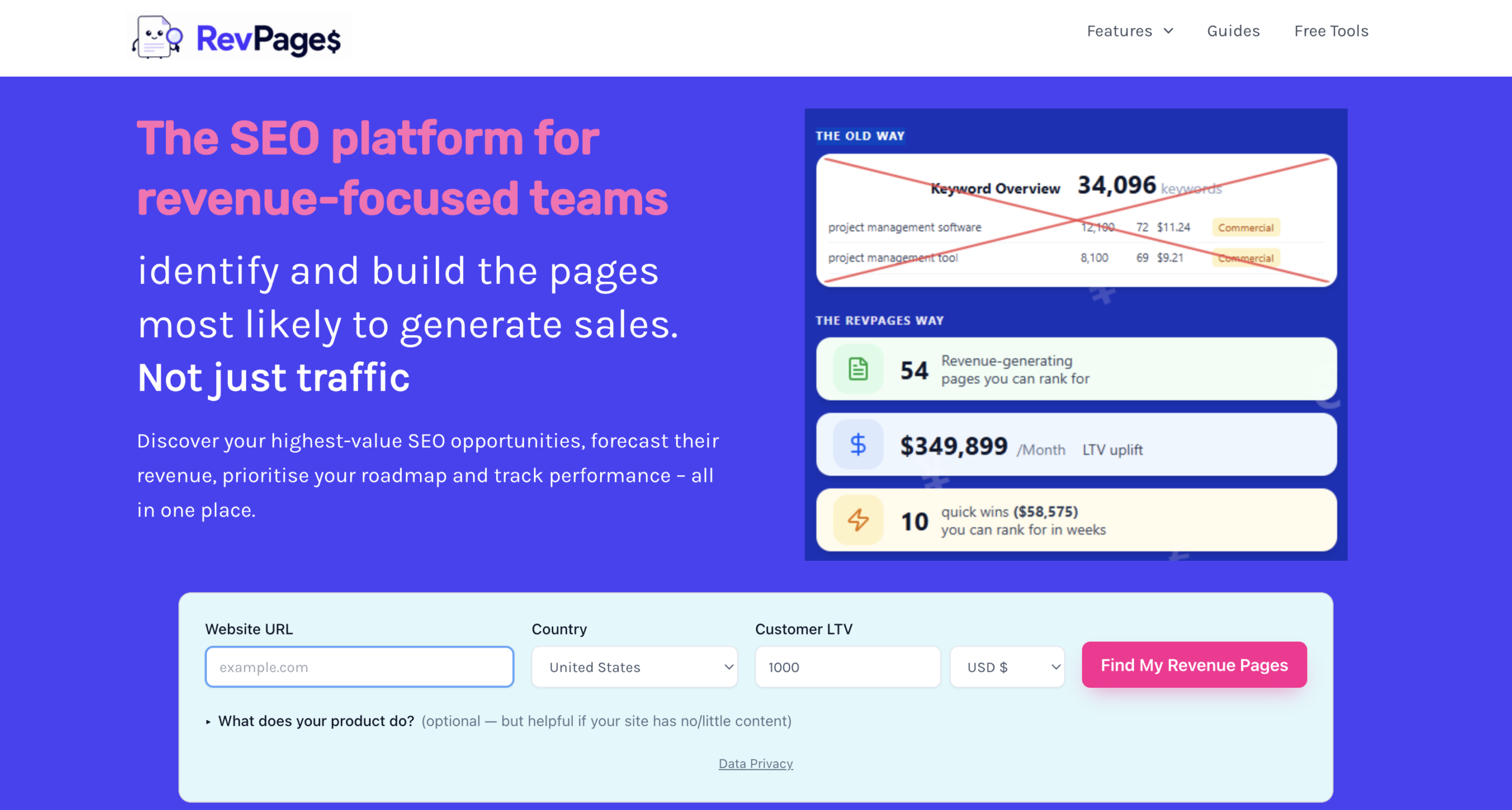
RevPages is an SEO platform designed specifically for revenue-focused SaaS teams.
Where most keyword tools return thousands of possible searches, RevPages identifies a smaller number of commercially valuable pages that a SaaS company could realistically create or optimise.
Users enter their website, target market and average customer lifetime value. RevPages then analyses the business, its existing rankings and relevant keyword data to identify high-intent opportunities across SaaS-specific page categories.
These can include:
- Competitor alternative pages
- Product comparison pages
- Feature and use-case pages
- Industry landing pages
- “Best software” list pages
- Templates and free resources
- Core product and software category pages
This structure makes RevPages particularly useful for SaaS businesses. Instead of beginning with a generic seed keyword and manually working through thousands of variations, the platform starts with the company’s product, audience, features and competitors.
Key Features
- Automated discovery of high-intent SaaS keyword opportunities
- Revenue forecasts for individual keywords and pages
- Opportunity scoring based on potential value and ranking achievability
- Analysis of current rankings and possible revenue uplift
- Separation of new-page opportunities from existing pages that could be improved
- Revenue-prioritised content roadmaps
- AI-generated content briefs
- Revenue-focused performance tracking
RevPages forecasts the potential value of an opportunity using factors such as search volume, expected click-through rate, page conversion rate and customer lifetime value. It also considers the site’s current position, allowing the platform to estimate the additional revenue that could be available from improving an existing ranking.
That distinction is important for SaaS teams. A traditional keyword tool might show two keywords with identical search volumes, even though one is an informational query from someone beginning their research and the other is a comparison search from a buyer actively choosing between products.
RevPages attempts to quantify this difference and prioritise the opportunity with the greater likely commercial impact.
Who It’s Best For
RevPages is best suited to SaaS founders, in-house marketing teams and specialist SEO agencies that want to connect keyword research more directly to customers and revenue.
It is particularly valuable for teams asking questions such as:
- Which landing page should we create next?
- Should we build a new page or improve an existing one?
- Which competitor comparisons are worth targeting?
- How much could reaching the top of Google for this keyword be worth?
- What should we add to next month’s content roadmap?
Pricing
RevPages is currently free, but paid plans will be introduced soon
Our Take
Most SEO tools are designed to provide data. RevPages is designed to turn that data into commercial decisions.
Its biggest advantage is its understanding of SaaS page types and buying intent. It does not treat a feature page, competitor comparison and general blog post as interchangeable keyword opportunities.
RevPages will not replace a full technical SEO or backlink-analysis platform. Teams conducting extensive competitor research may still want to use it alongside Ahrefs or Semrush. However, for identifying which SaaS pages are most likely to generate sign-ups and revenue, it is the strongest specialist option on this list.
Find your most valuable keyword opportunities with RevPages →
2. Ahrefs — Best for SaaS Competitor and SERP Research
Ahrefs is one of the most comprehensive SEO platforms available and an excellent option for SaaS companies conducting detailed competitor research.
Its Keywords Explorer provides search volumes, keyword difficulty estimates, traffic potential, ranking history and analysis of the pages currently appearing in the search results. Ahrefs says its keyword database contains billions of search terms, making it suitable for both broad category research and highly specific SaaS niches.
The platform becomes particularly valuable when research moves from individual keywords to competing websites.
A SaaS marketer can enter the domains of several direct competitors and investigate:
- Their highest-traffic pages
- The keywords for which they rank
- Recently acquired or lost positions
- Competitor pages attracting backlinks
- Keywords multiple competitors rank for
- Topics the marketer’s own website has not covered
Key Features
- Keywords Explorer
- Site Explorer
- Content Gap analysis
- SERP history and competitor comparison
- Keyword difficulty and traffic-potential metrics
- Backlink analysis
- Rank Tracker
- Content Explorer
The Content Gap tool is particularly useful for SaaS companies operating in established product categories. It can identify terms that several competitors rank for but the company’s own website does not.
However, SaaS teams should avoid automatically treating every competitor keyword as a worthwhile target. Competitors may rank for large numbers of high-traffic informational terms that generate few product sign-ups.
Ahrefs provides the data needed to discover and evaluate these keywords, but the user must still apply commercial judgement when choosing which opportunities to pursue.
Who It’s Best For
Ahrefs is best for experienced SaaS marketers, SEO professionals and agencies that want detailed control over keyword, competitor, backlink and SERP analysis.
It is especially useful when determining why a competitor ranks and what may be required to overtake it.
Pricing
Ahrefs offers a limited Starter plan from $29 per month, with its broader Lite plan starting from $129 per month at the time of writing.
Our Take
Ahrefs is the strongest all-round research platform in this list. Its combination of keyword, competitor, SERP and backlink data provides a detailed view of almost any SaaS search market.
Its main limitation is also a consequence of its scale: it can provide more data than a team knows what to do with. Ahrefs helps you find and investigate opportunities, but it will not necessarily tell you which keyword is most likely to generate revenue for your particular business.
Choose Ahrefs when depth of analysis matters and you have the SEO expertise to interpret the data.
3. Semrush — Best for Complete SEO Campaign Planning
Semrush is a broad digital marketing platform with tools covering keyword research, competitor analysis, content planning, rank tracking, backlinks and technical SEO.
Its Keyword Magic Tool can generate large numbers of related terms from a seed topic, while Keyword Gap compares the organic visibility of multiple competing domains.
For SaaS teams, one of Semrush’s most useful features is Keyword Strategy Builder. It automatically groups related keywords into topic clusters and maps them into a content plan, helping teams move from raw keyword research to a more organised site structure.
Key Features
- Keyword Magic Tool
- Keyword Gap analysis
- Organic Research
- Keyword Strategy Builder
- Automated topic clustering
- Search intent labels
- Position Tracking
- Site Audit
- SEO Content Template
Semrush is well suited to SaaS businesses targeting several connected topics.
For example, a platform serving financial services or logistics teams might need landing pages for distinct customer segments, supported by content about planning, collaboration, reporting and resource management.
Keyword Strategy Builder can group these searches into pillar topics and subpages, reducing the likelihood of several pages competing for essentially the same keyword.
Its combination of paid and organic search data can also be useful for SaaS companies running PPC and SEO campaigns simultaneously. High-performing paid search terms may reveal commercial opportunities that deserve permanent organic landing pages.
Who It’s Best For
Semrush is best for established SaaS marketing teams and agencies that want one platform covering most aspects of an SEO campaign.
It is also a good choice for companies coordinating keyword research, content production, competitor monitoring and technical optimisation across several team members.
Pricing
Semrush’s SEO Toolkit starts from $139.95 per month at the time of writing, with larger plans available for growing teams and agencies.
Our Take
Semrush offers a strong balance between keyword discovery and practical campaign planning.
Ahrefs may be preferable for marketers primarily concerned with detailed backlink and competitor analysis, while RevPages is more focused on SaaS-specific commercial opportunities. Semrush is the better fit for teams seeking a broad workflow that connects keyword research with clusters, tracking, optimisation and wider campaign management.
4. LowFruits — Best for Finding Achievable Long-Tail Keywords
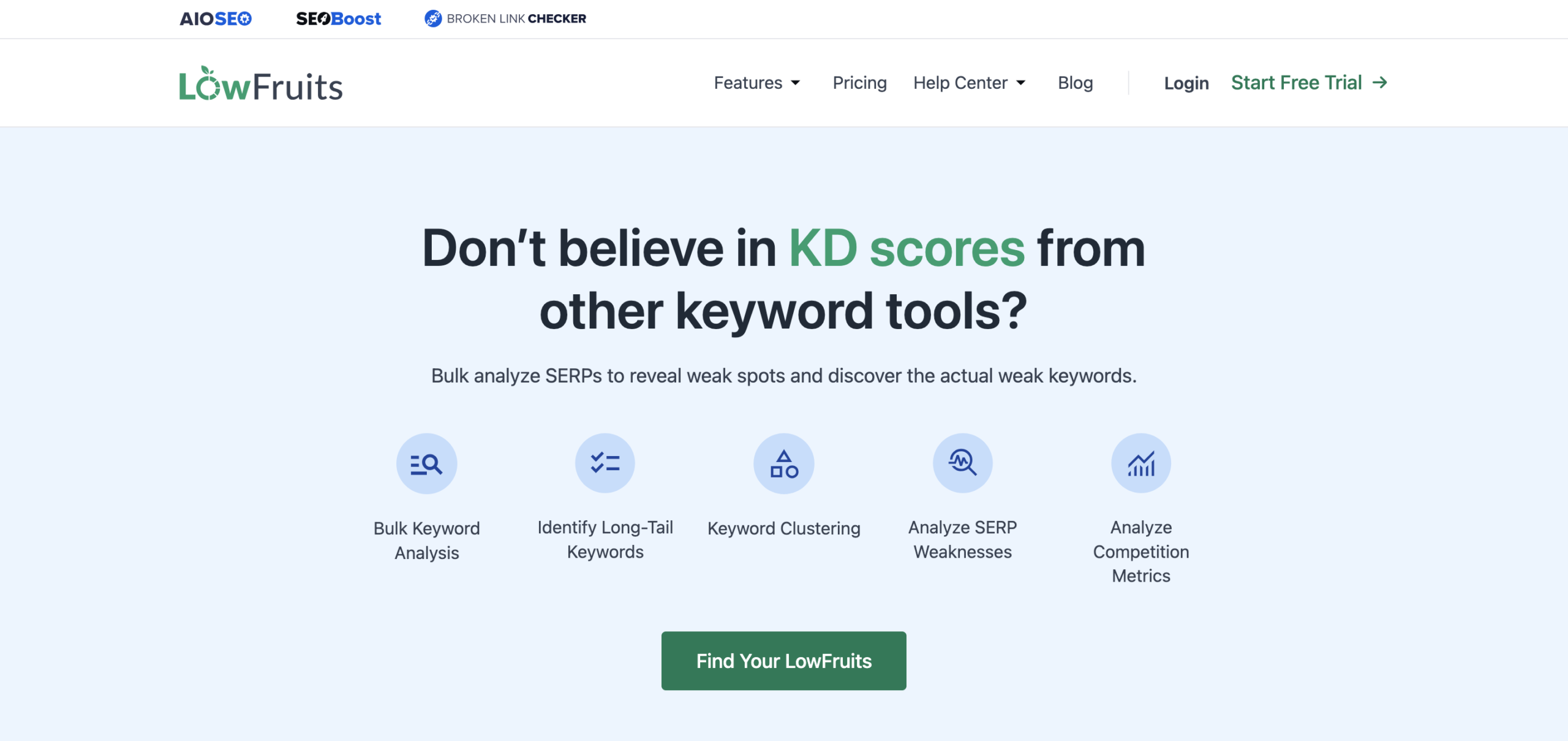
LowFruits is a keyword research and SERP-analysis platform built around finding weak competition in Google’s results.
Most keyword tools assign a difficulty score by looking at several authority and backlink signals. LowFruits makes the competitive landscape more visible by identifying “weak spots”: lower-authority websites or less competitive pages already ranking in the top results.
Its own guidance recommends looking for keywords with at least two weak spots in the top 10 rather than assuming that a single weaker result makes a keyword easy to rank for.
Key Features
- Long-tail keyword discovery
- Bulk SERP analysis
- Automatic weak-spot detection
- SERP difficulty scoring
- Competitor keyword extraction
- Keyword clustering
- Pay-as-you-go credits
This approach can be useful for early-stage SaaS companies whose websites do not yet have the authority to compete for major software category terms.
Instead of immediately targeting a broad phrase such as “accounting software”, a newer company could use LowFruits to uncover narrower searches related to particular users, features or problems where the existing results are less competitive.
These might include searches such as:
- Accounting software for independent consultants
- Invoice approval software for small businesses
- Accounting software with project tracking
- Alternatives to a niche competing product
These lower-volume terms will not always transform a company’s pipeline individually. However, a collection of commercially relevant long-tail pages can create an achievable starting point while the site builds authority.
Who It’s Best For
LowFruits is best for start-ups, smaller SaaS businesses and marketers working with newer or lower-authority domains.
It is also useful for experienced SEO teams that want to validate whether apparently low-difficulty keywords genuinely have vulnerable results on page one.
Pricing
LowFruits offers pay-as-you-go credits, with packages starting from approximately $25, alongside subscription plans.
Our Take
LowFruits solves a narrower problem than Ahrefs or Semrush, but it solves that problem well.
It is not the best platform for forecasting business value or managing an entire SaaS content programme. Its strength lies in helping marketers find keywords for which smaller websites may have a realistic chance of ranking.
For an early-stage SaaS company trying to win its first meaningful organic positions, that focus can be extremely valuable.
5. Keyword Insights — Best for Keyword Clustering and Content Briefs
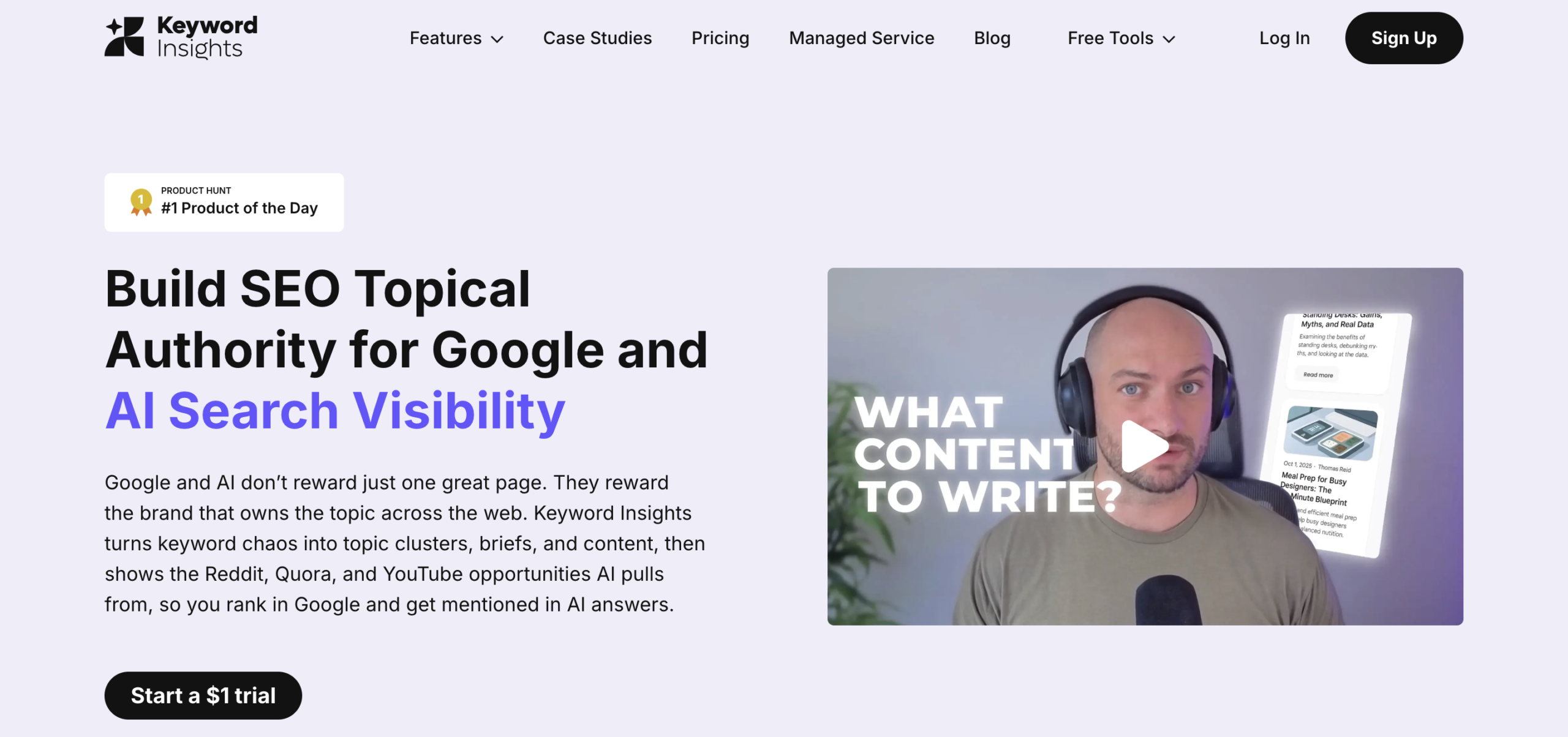
Keyword Insights helps marketers turn large, disorganised keyword lists into page-level clusters and actionable content plans.
This is an important part of SaaS keyword research because keyword discovery frequently produces many slight variations of the same search.
For example:
- CRM for recruitment
- Recruitment CRM software
- Best CRM for recruitment agencies
- Recruitment agency CRM
- CRM system for recruiters
Creating a separate page for every variation could lead to duplicated content and keyword cannibalisation. Combining every term into one broad page could overlook meaningful differences in search intent.
Keyword Insights addresses this by analysing overlap between the pages ranking for each query. Keywords with sufficiently similar search results can be grouped into the same cluster and targeted with one page. The platform also classifies intent and recommends a primary keyword for each group.
Key Features
- Keyword discovery
- SERP-based keyword clustering
- Search intent classification
- Recommended target keywords
- Content gap analysis
- AI-generated content briefs
- Writing and content-production tools
- Google Search Console and keyword-list imports
Its content briefs provide a logical next step after clustering. Rather than handing a writer a spreadsheet containing hundreds of terms, an SEO team can provide one brief with the target cluster, recommended structure and relevant topics.
Keyword Insights can therefore be particularly useful for SaaS companies producing content at scale or working with multiple writers, freelancers and agency partners.
Who It’s Best For
Keyword Insights is best for SaaS content teams and agencies that already have keyword data but need to organise it into a coherent production plan.
It is especially valuable when hundreds or thousands of terms must be mapped to the correct pages without creating duplication.
Pricing
Keyword Insights plans start from $58 per month, with credit allowances for clustering, briefs and other features.
Our Take
Keyword Insights bridges the gap between research and production.
It is not as comprehensive as Ahrefs or Semrush for competitor analysis, and it does not provide the SaaS-specific revenue prioritisation offered by RevPages. Its strength is converting keyword lists into a clean site and content structure.
If your keyword spreadsheet is growing faster than your ability to decide which pages to create, Keyword Insights is likely to be the most useful tool on this list.
How to Choose the Right Keyword Research Tool for Your SaaS Company
The right choice depends on the problem you are trying to solve.
Before selecting a platform, ask the following questions:
Do you need more keywords or better priorities?
Many SaaS companies do not suffer from a shortage of keyword ideas. They have hundreds or thousands of possible topics but no reliable way to decide which ones deserve investment.
If prioritisation and commercial value are your main challenges, RevPages is the strongest fit. If you need the largest possible pool of ideas and extensive supporting data, consider Ahrefs or Semrush.
How authoritative is your website?
Established SaaS websites can compete for broad product categories with substantial search volumes. Newer websites usually need to begin with narrower opportunities.
LowFruits can help younger sites identify search results containing weaker competitors, while Ahrefs provides deeper information about the authority and backlinks of the pages they will need to outrank.
Are you planning pages or individual keywords?
A successful SaaS SEO strategy should ultimately produce a roadmap of pages, not merely a spreadsheet of keywords.
RevPages organises commercially valuable searches around recognisable SaaS page types. Semrush builds pillar-and-subpage strategies, while Keyword Insights groups related searches according to overlap in the live results.
Do you need specialist or all-in-one software?
Specialist tools generally provide clearer answers to particular questions:
- RevPages: What should we create to generate revenue?
- LowFruits: Where are the easiest SERPs to compete in?
- Keyword Insights: Which keywords belong on the same page?
Broader platforms answer a wider range of questions:
- Ahrefs: What is ranking, why is it ranking and who links to it?
- Semrush: How do we research, organise, monitor and manage the wider campaign?
Many mature SaaS teams will benefit from combining one specialist platform with one broader SEO suite.
Conclusion
The best keyword research tool for a SaaS company depends on whether its immediate priority is discovery, competitive analysis, achievability, clustering or revenue.
RevPages leads this list because it is purpose-built around the commercial structure of SaaS SEO. It identifies feature, use-case, industry, comparison and alternative pages, forecasts their possible revenue and turns the strongest opportunities into a prioritised roadmap.
Ahrefs provides the deepest competitor and SERP research, while Semrush is an excellent all-round choice for teams managing larger SEO campaigns. LowFruits helps newer websites locate achievable long-tail terms, and Keyword Insights turns extensive keyword lists into page clusters and production-ready briefs.
Whichever platform you choose, avoid prioritising keywords based on search volume alone. The most valuable SaaS keyword is not necessarily the one capable of generating the most visits. It is the one that attracts the right prospective customers, matches your product and can realistically produce enough revenue to justify the investment.
Frequently Asked Questions
What is the best keyword research tool for SaaS?
RevPages is the best option for SaaS-specific, revenue-focused keyword research because it identifies commercially valuable SaaS page types and prioritises them using estimated revenue and ranking achievability.
Ahrefs and Semrush are stronger options when a team requires wider competitor, backlink and technical SEO capabilities.
What makes SaaS keyword research different?
SaaS keyword research must account for product features, integrations, industries, use cases, competing products and different stages of the software buying journey.
Search volume alone can be misleading because a low-volume comparison or use-case keyword may be much closer to a buying decision than a high-volume informational query.
Should SaaS companies target low-volume keywords?
Yes, when the keyword has strong commercial relevance.
A search performed by 50 well-qualified buyers may be more valuable than one performed by 5,000 people with no intention of purchasing software. Low-volume keywords are particularly attractive when they describe a specific use case, industry, integration or competitor comparison.
Which tool is best for SaaS competitor keyword research?
Ahrefs is the strongest choice for detailed competitor research because it combines organic keyword data with page-level traffic estimates, ranking history, SERP analysis and backlink information.
Semrush is also a strong option, particularly for teams that want to move competitor discoveries directly into clusters and a broader campaign plan.
Can one keyword tool manage the entire SaaS SEO process?
Some platforms cover most of the process, but no tool is strongest in every area.
A common SaaS SEO stack might use Ahrefs for deep competitor research and RevPages for revenue forecasting and prioritisation. Teams producing content at scale could add Keyword Insights for clustering and brief creation.
How should SaaS companies prioritise keywords?
Evaluate each opportunity using:
- Relevance to the product
- Position in the customer buying journey
- Search demand
- Likely conversion rate
- Customer lifetime value
- Current ranking position
- Ranking difficulty
- Resources required to create or improve the page
Combining commercial value with ranking achievability produces a more useful priority order than relying on volume or keyword difficulty alone.

