

During November – December 2025, we surveyed 110 IT & SaaS companies across the EU, US, and UK markets — the most comprehensive global inbound marketing market benchmark for B2B tech & SaaS to date. Here’s what we uncovered:
And much more. Download the report (available in English and Ukrainian) to discover which platforms, budgets, and tactics define success in 2026.


face declining leads despite maintaining marketing spend
now actively optimize for LLM visibility (ChatGPT, Perplexity, AI Overview)
guest posts exploded from 25% to 71% adoption (284% growth)
still don’t track ROI, creating a massive competitive gap
For the first time since we began tracking inbound marketing — including our 2025 report focused on Ukrainian B2B tech teams — throwing money at the problem doesn’t solve it. 47% of companies reported fewer B2B SaaS leads in 2025, despite keeping budgets stable at €1,000-€2,000/month for SEO. This is the defining B2B SaaS lead generation statistic of the year.

What changed?
This represents a structural shift in how users find information – and it’s permanent. The companies still winning have adapted: they’re not spending more, they’re spending differently.
While 47% of companies watch their leads decline, a small group is thriving. Our research found three critical advantages that separate market leaders from the rest:

In our inbound marketing report 2025, 77% planned to work on LLM visibility. In 2025, 40% are already generating leads from ChatGPT and Perplexity. The LLMO benefits for SaaS companies are now measurable: lower CAC, warmer intent, and faster sales cycles compared to traditional organic search.
What changed:
– 58% now budget €1,000+/month specifically for LLMO (separate from SEO)
– 27.2% of competitors haven’t started yet
– Early movers capture warmer leads at lower cost
What changed:
– Guest posts exploded from 25% → 71% adoption (+184%)
– PR grew from 12.5% → 44% (+252%)
– Budgets increased to €1,000-€5,000/month
One “Top 10 tools” guest post now delivers three things simultaneously, but most companies are still doing outreach the old way.

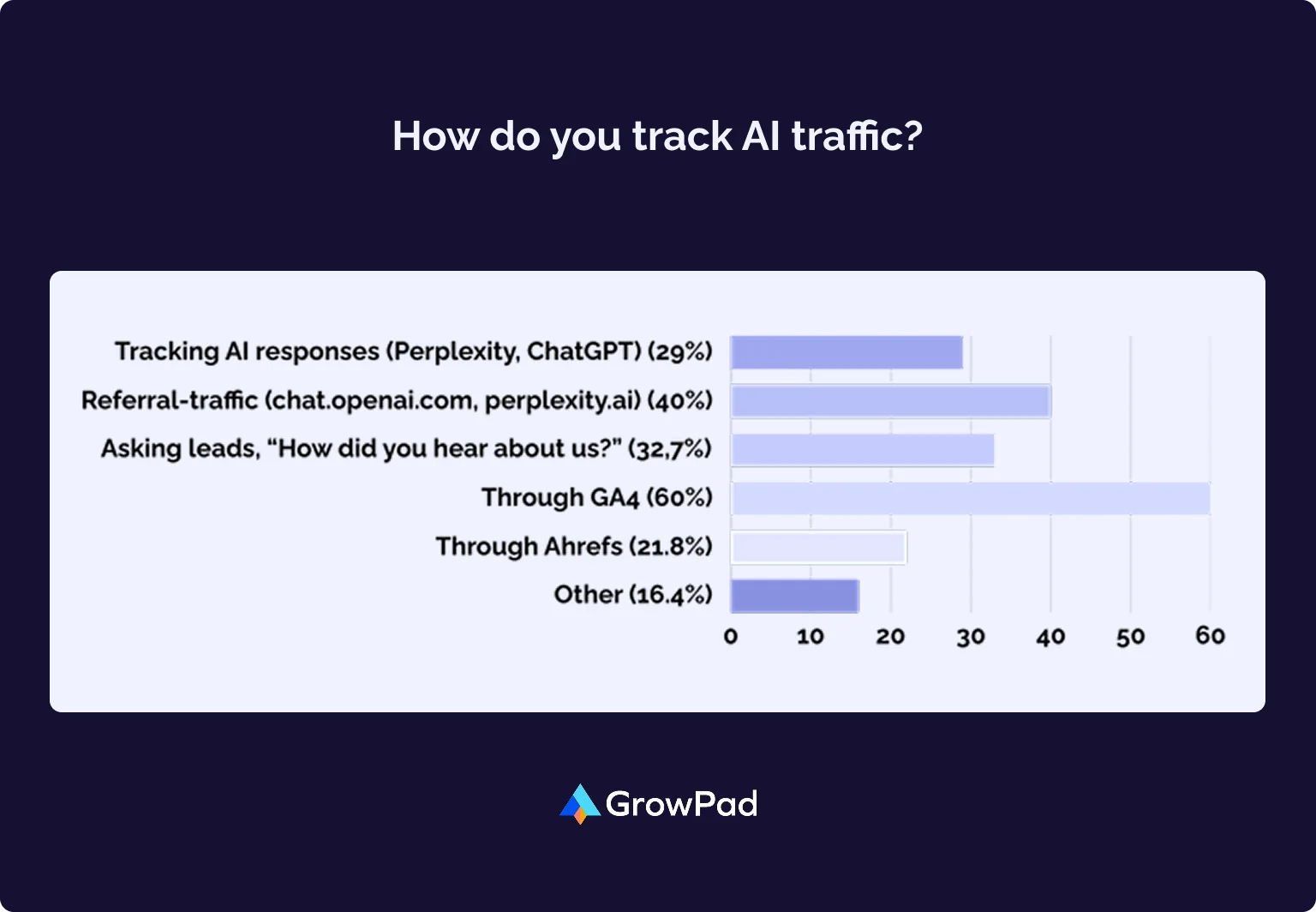
Over 50% companies don’t know which channels actually drive revenue. Companies without tracking wait 6+ months for SEO payback. Companies with proper attribution cut it to 3 months.
Market leaders now use:
– GA4 + CRM integration (60%)
– Referral traffic monitoring (40%)
– Direct lead attribution (32%)
Our analysis of 110 IT & SaaS companies reveals the exact tracking setups, SaaS marketing budget allocation formulas, and LLMO tactics that separate winners from the rest — including SEO ROI statistics broken down by company size, geography, and channel mix.
Grow leads, build inbound marketing systems, and boost visibility across Google, PR, and LLMs with GrowPad.
In November – December 2025, GrowPad surveyed 110 marketing leaders from IT Outsource, Product, SaaS, and Consulting companies across Europe, the US, and the UK — expanding on our 2025 Ukrainian market study to produce the first English-language AI search marketing statistics report for global B2B tech teams.

The research focused on:
Our respondents:
The 15-30% organic traffic drop in 2025 is a behavioral shift. Here’s what our research of 55 IT & SaaS companies revealed.
Primary causes: Google AI Overview answers queries directly in search results (zero-click searches dominate); LLM platforms (ChatGPT, Perplexity) replace Google for informational queries; Zero-Click Search became the standard for 30%+ of queries; and Google algorithm updates (fall 2024 – spring 2025) hit informational content hard.
The data from our Global LLMO & Inbound Marketing Report 2025: 47% of companies saw lead decline WITHOUT budget cuts; 63.6% now have 1-5% of organic traffic coming from AI sources (ChatGPT, Perplexity); and traditional SEO strategies (ranking #1) no longer guarantee clicks.
What changed: Users now get answers in search results or from AI assistants instead of clicking through to websites. Your content can rank #1 and still receive fewer visitors.
Solution: Companies must optimize for both Google rankings AND LLM citations. The winners are those who appear in AI Overview, ChatGPT responses, and Perplexity answers, not just Google’s blue links.
Yes, but your strategy must change. 84% of companies in our inbound marketing research 2025 for IT & SaaS continue using SEO, but they’ve fundamentally shifted their approach.
What’s different in 2025: SEO budgets stay at €1,000-€2,000/month (median); LLMO gets an additional €1,000+/month budget (58% of companies); content focus shifts from TOFU to BOFU.
The new SEO strategy: narrow-intent pages (product pages, specific solutions, case studies); BOFU content (comparisons, pricing, answers to commercial questions); listicles and expert rankings (AI algorithms prefer these for recommendations); and E-E-A-T optimization (Experience, Expertise, Authoritativeness, Trustworthiness matter more than ever).
Budget allocation: 27.2% plan to increase SEO spend, 45% maintain current levels, and focus shifts to quality and relevance over volume.
ROI reality: Companies still see 5-6 month payback, but those combining SEO + LLMO optimization can accelerate to 3 months. The companies abandoning SEO are losing market share to competitors who adapted.
40% of IT & SaaS companies in our LLMO & Inbound marketing research 2025 already generate leads from LLM platforms. Here’s exactly what they do.
Step 1: Understand how LLMs cite sources. LLMs prioritize authoritative, structured content with clear answers; they favor case studies, comparisons, and specific solutions over generic guides; listicles and expert rankings get cited most frequently.
Step 2: Content optimization tactics. Add structured data (schema markup for products, reviews, FAQs); create expert roundups (“Top 10 [category] tools” with specific criteria); write comparison content (“X vs Y: Which is better for [use case]”); include real data (statistics, survey results, benchmarks); and optimize for citations (clear attributions, quotable expert insights).
Step 3: Monitor your visibility. ChatGPT (42 companies tracking): manually search “[your category] tools” and see if you’re mentioned. Perplexity (27 companies): same process. Google AI Overview (12 companies): check if you appear in AI-generated summaries.
Step 4: Track AI traffic. GA4 (60% of companies); referral monitoring for chat.openai.com and perplexity.ai traffic (40%); lead attribution via “How did you hear about us?” (32%).
Budget: Companies allocate €1,000-€3,000/month specifically for LLMO (separate from SEO). Most competitors (27.2%) haven’t started yet, so early movers capture warmer leads while the market catches up.
Link building transformed dramatically in 2025. The data from 55 IT tech & SaaS companies shows the following.
Top methods (by adoption rate): Guest posts 71% (exploded from 25% in 2025, 284% growth); Outreach 57.7% (down from #1 position); Insert links 55.7% (massive growth); PR 44% (up 252% from 12.5%); Partner homepage links 23%.
Why guest posts exploded: Expert listicles (“Top 10 X tools for [niche]”) deliver traditional backlink value for Google, LLM citation opportunities (ChatGPT/Perplexity recommend tools from these lists), and direct referral traffic.
Budget reality: Median €1,000-€5,000/month (up from $1,000 in 2025); 30% increasing investment; 57.7% maintaining current spend.
Emerging tactics for 2026: Reddit for links (community engagement + backlinks); listicles for partners (“Top tools” articles featuring partners); PR + links combo (media coverage that includes backlinks); insert links (adding links to existing relevant content on partner sites).
Critical shift — relevance over Domain Rating: Companies now prioritize platform relevance over high DR scores. A DR 40 niche site outperforms a DR 70 generic site. What doesn’t work: PBNs (only 7% use them, risky and low ROI) and low-quality guest posts (Google penalties increased). The strategy: combine guest posts (71%) + outreach (57.7%) + PR (44%) for a diversified link profile that satisfies both Google and LLMs.
AI content went from “experiment” (2024) to mainstream strategy (2025). Here’s what our LLMO & Inbound Marketing research found.
Adoption rates: 63.6% use AI for partial content writing (up from 52% in 2024); 30.9% use AI for content briefs; 24% use AI for full drafts (with human editing); only 13% don’t use AI at all.
How companies use AI: AI generates draft, human edits (64%, most common); AI creates brief, human writes (31%); AI writes full article, minimal editing (24%).
The quality breakthrough: In 2024, companies feared “shadow bans” from AI content. In 2025, the narrative shifted: AI content works for authority and rankings if done well — meaning AI generates the draft, experts review and add unique insights, humans fact-check and edit, and SEO and LLM optimization are applied. NOT fully automated template content.
Results: 2-3x more content for the same budget; no Google penalties when properly edited; competitive advantage for teams that mastered AI workflows. Writers evolved into AI process managers, strategists, and expert editors. Best practice: use AI for speed, humans for expertise. No client in our study generates 100% AI content without review.
The challenges shifted from tactical (2024) to structural (2025). Here’s what blocks growth based on the Global LLMO & Inbound Marketing Research from GrowPad.
1. Technical debt (36%) — the #1 problem. Old website code blocks AI indexing, poor site architecture prevents LLM crawling, and years of unclosed backlog tasks block new LLMO tactics.
2. Lack of strategy (34.5%) — companies don’t know how to integrate LLM into the marketing mix; 22% don’t know which priorities to focus on; they need a clear Inbound + LLMO roadmap.
3. ROI tracking failure (50%+) — a new critical issue. Over half don’t measure content marketing, SEO, or LLMO ROI, so they can’t justify budgets, optimize spending, or scale what works.
4. Budget constraints (18%) — not enough money for new approaches, but data shows it’s allocation, not amount.
5. Overloaded teams — in-house teams lack time for strategic work; tactical tasks eat all capacity.
What changed from 2024: the 2024 top challenge was video content (67%) and AI-generated content risks (42%) — both “solved” in 2025 and replaced by structural problems. Companies that fix ROI tracking + technical debt and get a clear strategy will outperform competitors by 2-3x in 2026-2027.
In 2025, SaaS inbound marketing continues to be one of the most effective growth strategies for tech companies. The best high-ROI marketing channels focus on driving organic, scalable, and cost-effective customer acquisition. Here are the top-performing channels delivering the highest returns:
SEO and Content Marketing: High-quality, keyword-optimized content remains the backbone of inbound marketing. Blog articles, whitepapers, and case studies targeting user pain points improve organic reach and establish authority.
Email Marketing & Automation: Personalized email sequences nurture leads effectively, keeping engagement high and reducing churn. Automated email campaigns convert trial users into paying customers.
Webinars & Virtual Events: Live and on-demand educational webinars help SaaS brands generate SQLs (Sales Qualified Leads) by showcasing product solutions to engaged audiences.
LinkedIn & Community Marketing: As social proof becomes more important, LinkedIn networking and niche communities drive engagement and industry authority.
Podcast & Video Marketing: SaaS companies are leveraging video explainers, customer testimonials, and podcasts to humanize their brand and improve customer retention.
A multi-channel inbound strategy combining these methods ensures sustained lead generation, lower CAC (Customer Acquisition Costs), and increased MRR (Monthly Recurring Revenue) for SaaS brands in 2025.
A strong SaaS content strategy is essential for attracting and converting leads in 2025. Unlike traditional outbound marketing, content-driven inbound lead generation educates, nurtures, and builds trust before a potential customer makes a purchase decision. Here’s how content marketing drives customer acquisition:
Organic Search Traffic Growth: SEO-optimized blog posts, landing pages, and industry reports improve search rankings, making it easier for potential customers to discover your SaaS solution.
Thought Leadership & Brand Authority: High-value content such as whitepapers, case studies, and research reports positions your brand as an industry expert, influencing decision-makers.
Lead Magnets & Gated Content: Downloadable resources like eBooks, guides, and checklists encourage visitors to share their contact details, fueling email nurturing campaigns.
Conversion-Driven Product Content: Explainer videos, product comparison articles, and feature deep dives help users understand how your software solves their pain points.
Personalized Content for Different Funnel Stages: Top of the Funnel (ToFu): blog posts, industry trends, and educational content. Middle of the Funnel (MoFu): case studies, webinars, and product demos. Bottom of the Funnel (BoFu): pricing pages, testimonials, and ROI-focused content.
By aligning your SaaS content strategy with the buyer’s journey, you attract high-intent users, improving inbound lead generation and trial-to-paid conversion rates.
SaaS conversion optimization (CRO) is crucial for turning website visitors into trial users, paid customers, and long-term subscribers. The best-performing SaaS companies in 2025 leverage data-driven CRO tactics to maximize lead-to-customer conversion rates. Here’s what works best:
Streamlined Sign-Up Process: Reduce form fields, implement social logins (Google, LinkedIn), and optimize CTAs to improve sign-up rates.
Personalized User Experience: Use AI-driven insights to deliver tailored product recommendations, content suggestions, and onboarding flows.
Landing Page Optimization: High-converting SaaS landing pages use compelling headlines, trust signals (testimonials, case studies), and clear value propositions to increase demo requests and trial sign-ups.
Behavioral Analytics & A/B Testing: Tools like Hotjar, Crazy Egg, and Google Optimize help analyze user behavior, allowing marketers to refine page layouts, CTA placement, and messaging.
Live Chat & Chatbots: AI-powered chatbots answer real-time customer queries, increasing engagement and reducing bounce rates.
Exit Intent Pop-Ups & Retargeting: Capture users before they leave with discount offers, free trial extensions, or lead magnets to encourage sign-ups.
By focusing on SaaS conversion optimization through A/B testing and UX improvements, companies can achieve higher activation rates, better retention, and increased revenue per user.
SaaS marketing trends in 2025 are being shaped by emerging technologies that enhance automation, personalization, and predictive analytics. These innovations improve how SaaS companies attract, engage, and convert leads:
AI-Powered SEO & Content Creation: Tools like ChatGPT, Jasper, and Clearscope are helping marketers generate SEO-optimized content, automate topic research, and predict user intent.
Voice Search & Conversational AI: As smart assistants (Alexa, Google Assistant) gain traction, voice search optimization is becoming critical for long-tail keyword targeting.
Interactive & Dynamic Content: SaaS brands are using quizzes, calculators, and interactive demos to boost engagement and improve lead qualification.
Blockchain & Decentralized Marketing: IT & SaaS companies in fintech and cybersecurity are exploring blockchain-powered data security and transparent ad tracking to enhance trust.
Hyper-Personalization with AI & Machine Learning: AI-driven predictive analytics, smart email segmentation, and real-time personalization ensure highly targeted user experiences.
These inbound marketing innovations will define the next decade of SaaS growth, allowing companies to scale customer acquisition more efficiently.
AI-driven marketing is transforming SaaS inbound marketing strategies by improving customer targeting, lead nurturing, and content personalization. In 2025, successful SaaS companies leverage AI and automation in the following ways:
AI-Powered Chatbots & Conversational Marketing: Chatbots enhance 24/7 customer engagement, answer FAQs, and guide users through product discovery.
Automated Lead Scoring & CRM Integration: AI analyzes user behavior to assign lead scores, ensuring sales teams focus on high-potential prospects.
Smart Email Marketing & Personalization: AI enables dynamic email sequences, sending the right message at the right time to boost conversions.
Predictive Analytics for Customer Retention: Machine learning predicts churn risks and user intent, allowing companies to deploy proactive retention strategies.
SEO & Content Automation: AI helps optimize blog posts, suggest internal links, and identify keyword gaps, improving organic rankings.
With SaaS marketing automation, businesses reduce manual effort while enhancing efficiency, customer engagement, and revenue growth.
Despite the benefits of SaaS inbound marketing, companies face key challenges that impact lead generation and customer retention:
High Competition in Organic Search: The growing number of SaaS companies makes it harder to rank for competitive keywords without a strong SEO strategy.
Long Sales Cycles & Lead Nurturing Complexity: SaaS buyers take longer to evaluate and purchase, requiring advanced email automation and remarketing to keep them engaged.
Content Saturation & Differentiation: With thousands of SaaS blogs, brands must focus on unique, data-driven insights to stand out.
Customer Churn & Retention Struggles: Inbound marketing must extend beyond acquisition and include customer success strategies to reduce churn.
Overcoming these SaaS inbound challenges requires a data-driven approach, AI-powered automation, and multi-touchpoint engagement strategies.
We’ll send the report to your email within one business day after you complete the form.
Yes — the insights are designed to help you build your own strategy. But for a sharper start and more focused execution, we recommend booking a consultation.
Track these core KPIs: conversions, CAC, and ROI. The report includes detailed guidance on how to plan budgets to reach them.
Yes, the report is free and available after submitting a short form. No spam, we promise.

We guide your ideal clients to you by blending SEO, GEO, and LLMO, as well as content briefs and link building into a cohesive inbound marketing strategy.
Growpad Digital Growth S.L.B26742650
Avinguda Goleta, 3, local 7, despacho 4, Alicante, Spain, 03540
Tel: +34624126313
