

Based on GrowPad’s Global LLMO & Inbound Marketing Research — the most comprehensive benchmark for B2B tech & SaaS inbound marketing to date.
The rules of inbound marketing changed in 2025 and most SaaS companies didn’t get the memo in time. Organic traffic dropped 15–30% across the board. Nearly half of IT & SaaS companies lost leads without cutting a single euro from their budgets. And the strategies that reliably drove growth for the past decade started to show cracks.
To understand exactly what’s happening (and what the top performers are doing differently) GrowPad surveyed 110 IT & SaaS companies across the EU, US, and UK between November and December 2025. This follows our 2025 benchmark focused on Ukrainian B2B tech teams (45 companies), making it possible to track year-over-year shifts with real data.
What you’ll find in this post: 50+ inbound marketing statistics for SaaS and B2B tech, covering budgets, SEO, link building, LLMO (LLM Optimization), content, and ROI tracking. All data points reference our full 2026 Inbound Marketing Report, which is available for free download in English and Ukrainian.
The State of B2B SaaS Inbound Marketing in 2026
The headline finding from our 2026 research is one no marketer wants to see: 47% of companies reported fewer B2B SaaS leads in 2025 despite maintaining stable marketing budgets. This is not a budgeting problem. It’s a structural shift in how users find information, and it’s permanent.
Three forces drove this:
- Google AI Overview now answers queries directly in search results, reducing click-through rates significantly
- Zero-click searches account for 30%+ of all queries in 2025
- LLM platforms (ChatGPT, Perplexity) are replacing Google for informational and research-intent queries
The companies still winning haven’t simply spent more: they’ve reallocated and adapted their inbound strategy. Here’s what the data shows.
SaaS Marketing Budget Statistics
How IT & SaaS Companies Allocate Their Marketing Budgets
Our 2025 Ukrainian market report (45 companies) established a strong baseline:
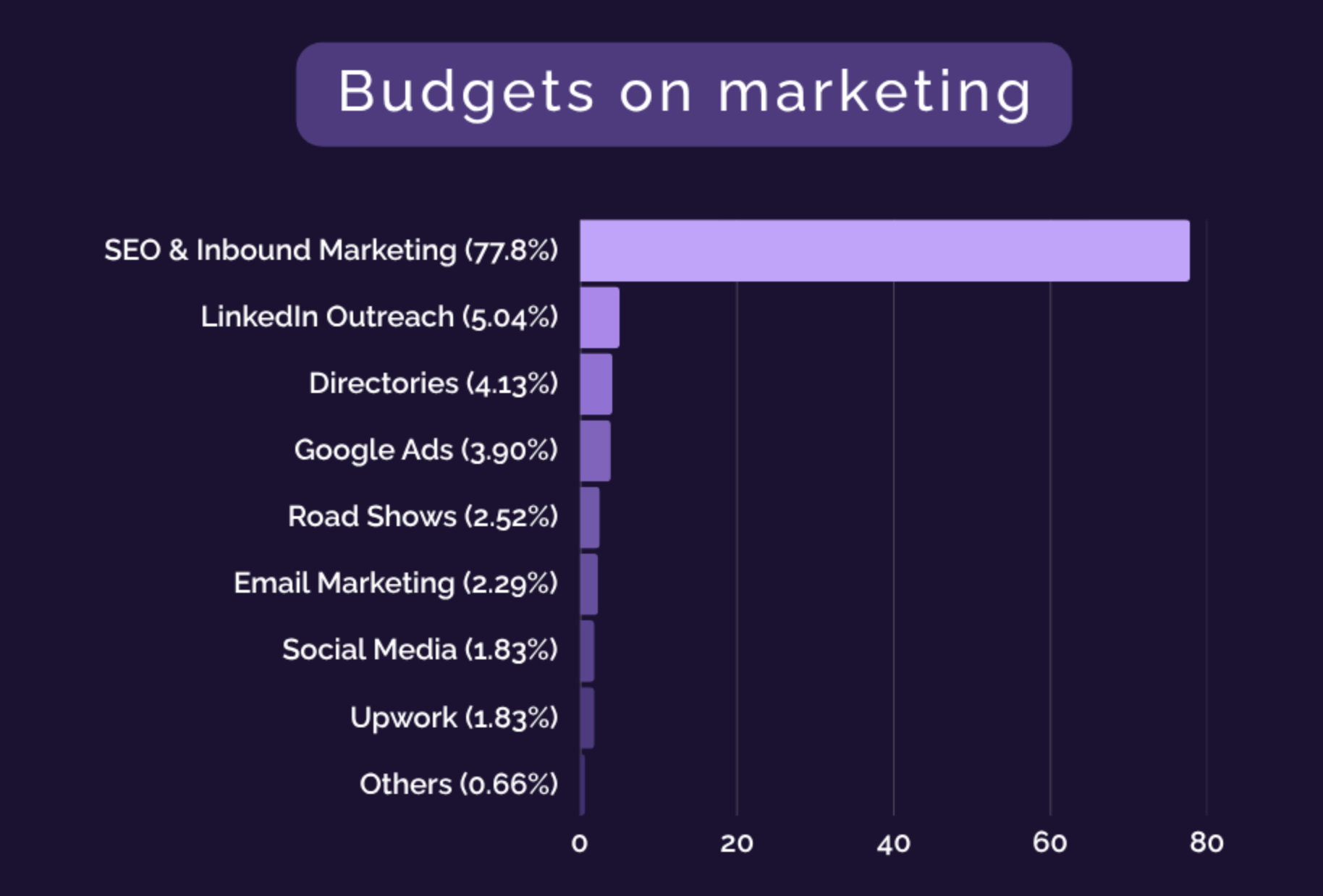
- 77.8% of total marketing budgets flow into SEO & Inbound Marketing
- LinkedIn outreach accounts for 5.04% of budgets
- Directories account for 4.13%
- Google Ads account for just 3.90%
- SEO & Inbound Marketing represent 26.8% of total marketing spend
By 2026, the picture became more nuanced. The median SEO budget held steady at €1,000–€2,000/month, but a new budget line appeared for most companies: dedicated LLMO spend.
- 58% of companies now allocate €1,000+/month specifically for LLMO, separate from their SEO budget
- 27.2% of companies plan to increase SEO spend in 2026
- 45% plan to maintain current SEO spending levels
- 18% cite budget constraints as their primary growth barrier
The key insight: it’s not the amount that separates winners from the rest — it’s the allocation. Companies that continue treating SEO and LLM visibility as the same budget line are systematically underinvesting in the channel that now drives warmer, faster-converting leads.
Link Building Budget Trends
Link building budgets tell a similar story of strategic escalation:
- Median link building spend: €1,000–€5,000/month (up from approximately $1,000 in the 2025 Ukrainian benchmark)
- 30% of companies are actively increasing link building investment
- 57.7% are maintaining current spend levels
SEO Statistics for SaaS Companies in 2026
The SEO Competition Problem
In our 2025 survey of Ukrainian IT & SaaS teams, 71% reported rising SEO competition as a primary challenge. This was the top concern at the time. By 2026, competition pressure has been compounded by a more fundamental problem: even when you rank, you may not get the click.
Key SaaS SEO statistics from our 2026 research:
- 15–30% organic traffic drop reported across companies over the last 12 months
- 84% of companies continue using SEO as a core channel — abandonment is not the answer
- 47% saw lead decline despite maintaining budget, pointing to a strategy problem rather than a spend problem
- 63.6% of companies already see 1–5% of their organic traffic coming from AI sources (ChatGPT, Perplexity, AI Overview referrals)
SEO ROI & Payback Period Statistics
One of the most persistent SaaS marketing challenges is the time required to see SEO results. Our 2025 benchmark established the baseline:
- 60%+ of companies wait 6+ months before seeing positive SEO ROI
- Only 18% achieve payback within 3 months
Our 2026 data shows a path to compressing that timeline, but it requires combining SEO with proper attribution:
- Companies with GA4 + CRM integration cut payback from 6 months to 3 months
- 50%+ of companies still don’t track which channels actually drive revenue
- Companies without ROI tracking wait consistently longer for measurable returns
The numbers make a clear case: ROI tracking is no longer a “nice to have”. It’s the fastest lever for improving inbound marketing performance.
LLMO & AI Search Statistics for B2B Tech
LLM Visibility Adoption
This is the fastest-moving category in our 2026 inbound marketing research. The shift from intent to action happened remarkably quickly:
- In our 2025 Ukrainian market report: 77% of companies planned to work on LLM visibility
- In our 2026 global research: 63% of companies are now actively optimizing for LLM visibility (ChatGPT, Perplexity, Google AI Overview)
- 40% of IT & SaaS companies are already generating leads from ChatGPT and Perplexity
The companies that moved early are capturing a tangible advantage: lower customer acquisition costs, warmer prospect intent, and faster sales cycles compared to traditional organic search.
What AI Traffic Looks Like Right Now
- 63.6% of companies now see 1–5% of organic traffic from AI sources
- 27.2% of competitors haven’t started LLMO optimization at all, making this a window of opportunity for early movers
- 58% budget €1,000+/month specifically for LLMO (separate from SEO spend)
How Companies Track LLM Visibility
Among the companies actively monitoring their AI search presence:
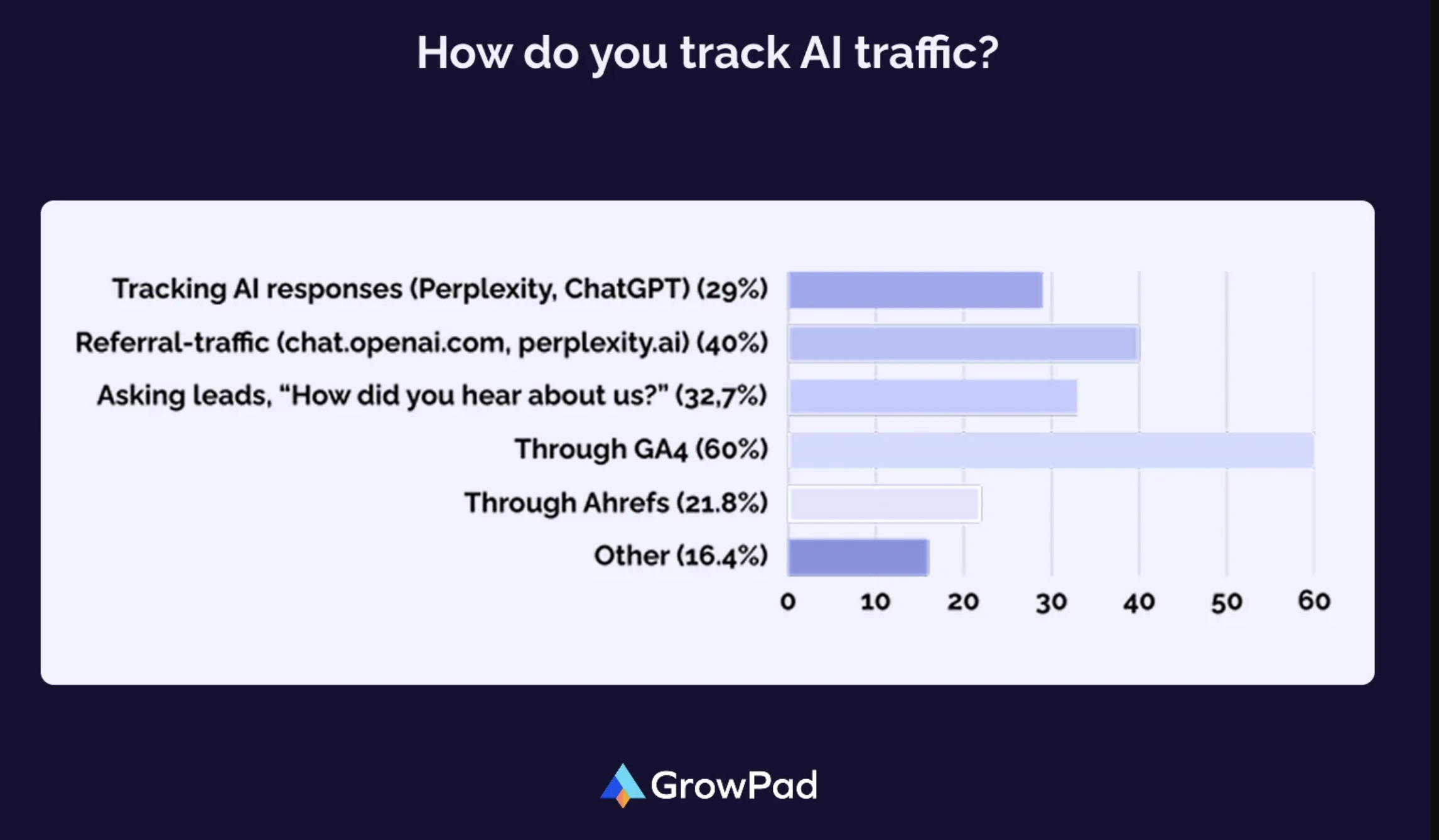
- 60% use GA4 as their primary tracking method
- 40% monitor referral traffic from chat.openai.com and perplexity.ai
- 32% use direct lead attribution (“How did you hear about us?”)
- 42 companies track manually via ChatGPT searches; 27 companies track via Perplexity
Link Building Statistics for SaaS & IT Companies
The Guest Post Explosion
Perhaps the most dramatic single statistic in our 2026 report is the growth in guest post adoption. This wasn’t a gradual shift, it was a complete reversal of the link-building hierarchy:
- Guest post adoption: 25% (2025) → 71% (2026) — a 284% increase in one year
- PR as a link-building method: 12.5% (2025) → 44% (2026) — a 252% increase
- Insert links: grew to 55.7% adoption (significant increase year-over-year)
- Traditional outreach: 57.7% (down from the #1 position it held in 2025)
- Partner homepage links: 23% adoption
Why Guest Posts Became the Dominant Link Building Tactic
A single guest post on a relevant niche platform now delivers three outcomes simultaneously:
- A traditional Google backlink — domain authority and ranking signal
- LLM citation potential — “Top 10 tools for [niche]” listicles are frequently cited by ChatGPT and Perplexity
- Direct referral traffic — readers who click through with commercial intent
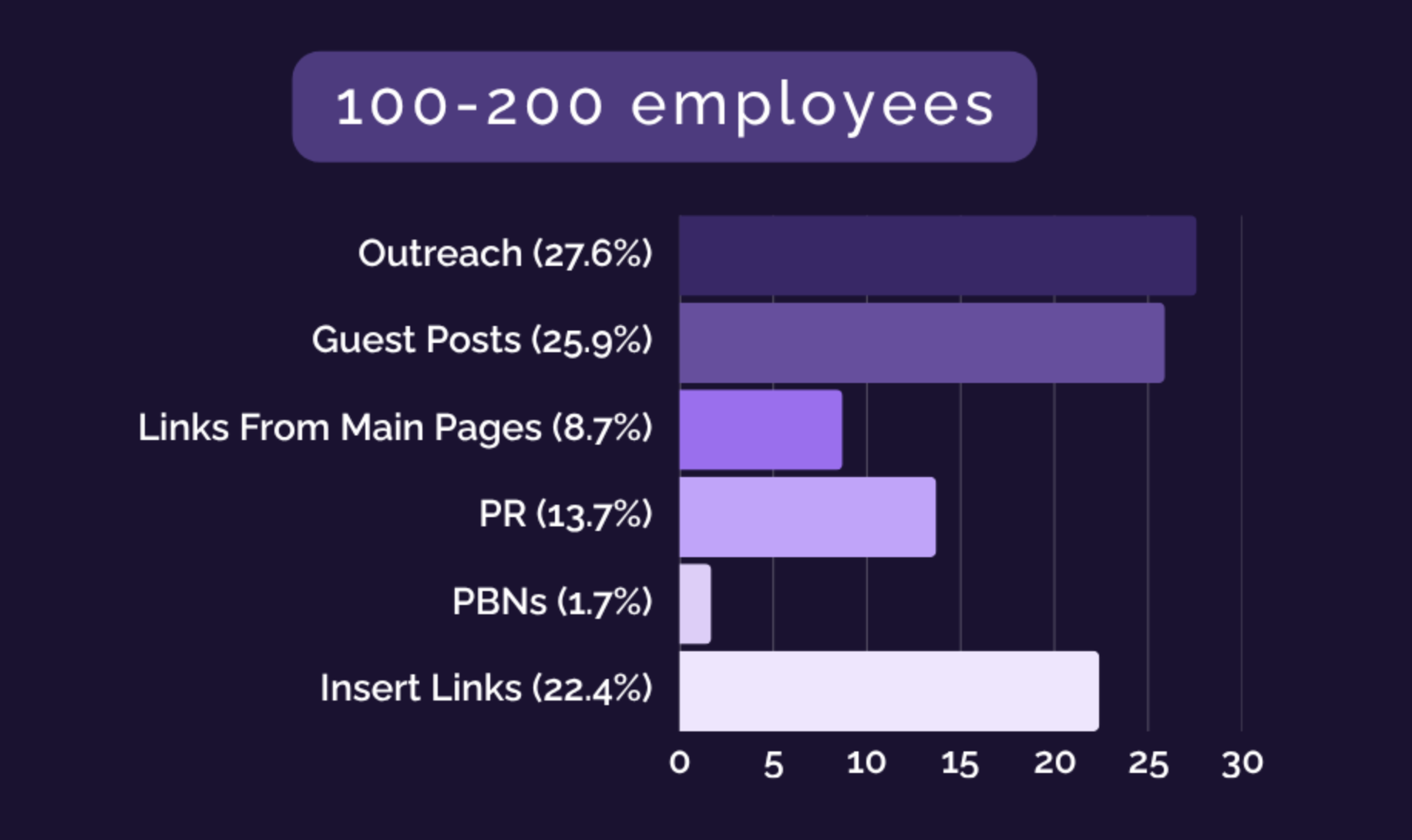
This triple return on a single placement changed the ROI math for link building. The strategic shift is reflected in budget allocation: mid-sized companies (100–200 employees) now balance outreach (27.6%), guest posts (25.9%), and insert links (22.4%) as their primary methods.
Tactics That No Longer Work
- PBNs (Private Blog Networks): Only 7% of companies still use them; considered high-risk, low-ROI
- Low-quality guest posts: Google penalties have increased; volume without relevance now backfires
- High-DR-only targeting: Companies now prioritize platform relevance over Domain Rating: a DR 40 niche site outperforms a DR 70 generic site
Content Marketing Statistics for SaaS in 2025–2026
AI Content Adoption
The 2024 concern about AI-generated content leading to Google penalties has largely been resolved with an important caveat about how AI is used:
- 63.6% of IT & SaaS companies use AI for partial content writing (up from 52% in 2024)
- 30.9% use AI to create content briefs (with humans writing the article)
- 24% use AI for full drafts, then have humans edit and add expertise
- Only 13% don’t use AI in their content workflow at all
The workflow that avoids penalties and performs well: AI generates a draft → subject matter expert reviews and adds proprietary insights → human editor fact-checks and optimizes → SEO and LLM optimization applied before publishing.
No company in our study generates 100% AI content without human review. The “fully automated” approach remains a fringe behavior, and a risky one.
Content Strategy Shifts
In our 2025 Ukrainian benchmark, 42% of companies identified AI-generated content as a major threat to credibility. By 2026, the conversation has moved from fear to execution: the companies that figured out the AI content workflow are now producing 2–3x more content for the same budget while maintaining quality.
The content types that now drive the most inbound marketing ROI for SaaS:
- BOFU comparisons (X vs Y for [use case]) — high commercial intent, LLM citation-friendly
- Pricing breakdowns and feature deep-dives — cited frequently by AI assistants
- Case studies and proprietary data — E-E-A-T signals that LLMs weight heavily
- Expert roundups and “Top tools” listicles — the format most frequently cited across ChatGPT and Perplexity
ROI Tracking Statistics for Inbound Marketing
The most actionable gap our 2026 research found is not in tactics or budgets, it’s in measurement:
- 50%+ of IT & SaaS companies don’t know which marketing channels drive their revenue
- Companies without proper tracking consistently experience 6+ month SEO payback periods
- Companies with proper attribution consistently achieve 3-month payback periods
- 60% of market leaders use GA4 + CRM integration as their measurement foundation
- 40% monitor referral traffic actively
- 32% use direct lead attribution methods

The 50% without tracking are effectively flying blind, unable to justify budget increases, optimize allocation, or scale what’s working. In a competitive environment where early LLMO movers are already generating measurable lead flow, this gap will widen quickly.
The Biggest Inbound Marketing Challenges for SaaS in 2026
Our research asked companies to identify their primary growth blockers. The results show a shift from tactical problems (2024) to structural ones (2025–2026):
#1 Technical debt — 36% of companies
Old website code blocks AI indexing, poor site architecture prevents LLM crawling, and accumulated technical backlog blocks implementation of new tactics.
#2 Lack of clear strategy — 34.5% of companies
Companies don’t have a clear roadmap for integrating LLMO into their existing inbound mix. 22% specifically don’t know which priorities to focus on first.
#3 ROI tracking failure — 50%+ of companies
This cross-cuts every other challenge. Without measurement, companies can’t justify investment, optimize channel mix, or scale.
#4 Budget constraints — 18% of companies
Data suggests this is often an allocation problem rather than a total-budget problem.
#5 Overloaded in-house teams
Tactical execution consumes all available capacity, leaving no time for strategic work, analysis, or new channel testing.
For comparison, the top challenges in 2024 were video content (67%) and AI-generated content risks (42%) — both considered largely “solved” by 2025 and replaced by these structural barriers.
Key Inbound Marketing Statistics Summary
For quick reference, here are the most important data points from GrowPad’s 2025 and 2026 research:
Budget & spend:
- 77.8% of marketing budgets flow to SEO & Inbound (2025 Ukrainian benchmark)
- Median SEO spend: €1,000–€2,000/month
- 58% now allocate €1,000+/month separately for LLMO
- Median link building budget: €1,000–€5,000/month
Performance & ROI:
- 47% of companies lost leads despite stable budgets
- 15–30% organic traffic drop across the board in 12 months
- 60%+ wait 6+ months for SEO ROI
- Proper tracking cuts payback to 3 months
LLMO & AI search:
- 63% actively optimize for ChatGPT, Perplexity, AI Overview
- 40% generate leads from LLM platforms already
- 63.6% see 1–5% of traffic from AI sources
- 27.2% haven’t started LLMO yet
Link building:
- Guest posts: 25% → 71% adoption (+284% in one year)
- PR adoption: 12.5% → 44% (+252%)
- Insert links: 55.7% adoption
- Only 7% still use PBNs
Content & AI:
- 63.6% use AI for partial content writing
- 13% don’t use AI at all
- 2–3x more content output for teams with optimized AI workflows
Measurement:
- 50%+ don’t track inbound marketing ROI
- 60% of leaders use GA4 + CRM integration
- 71% faced rising SEO competition (2025 benchmark)
Conclusions: What the Statistics Tell Us to Do Differently
The SaaS inbound marketing statistics from 2025–2026 paint a consistent picture: the fundamentals still matter, but the execution has to evolve.
SEO isn’t dead, but standalone SEO is underperforming. 84% of companies continue to invest in SEO, and they’re right to. But the companies achieving 3-month ROI payback are combining SEO with LLMO optimization and proper attribution — not relying on organic rankings alone.
LLM optimization is no longer optional. With 63% of companies actively optimizing for AI visibility and 40% already generating leads from ChatGPT and Perplexity, the window for “early mover” advantage is closing. The 27.2% that haven’t started are accumulating a competitive deficit.
Guest posts are the highest-leverage link-building investment. The 284% growth in adoption isn’t a coincidence. It’s because the format serves three simultaneous purposes (Google backlink, LLM citation, referral traffic). This is where link building budgets should be concentrating.
Measurement is the fastest performance lever available. With 50%+ of companies flying blind, adding proper GA4 + CRM attribution is the single change most likely to accelerate ROI without increasing spend.
Technical debt is blocking strategy, not just performance. 36% of companies identify technical issues as their primary growth barrier — not budget, not competition. Clearing that backlog is a prerequisite for everything else.
The full dataset, including exact budget allocation formulas, tracking setups, and LLMO tactics broken down by company size and geography, is available in the GrowPad Inbound Marketing Report 2026. Free download, available in English and Ukrainian.
Research methodology: 110 IT & SaaS companies surveyed November–December 2025. Respondents: primarily CMOs and Heads of Marketing at companies with 20–500+ employees, serving EU, US, and UK markets. Comparison data from GrowPad’s 2025 Ukrainian market benchmark (45 companies, November–December 2024).

