

LAW FIRM AEO/GEO CASE STUDY
Law Firm AI SEO Case Study: How an IT Law Firm Reached #1 in AI Answers Across 3 Service Clusters
About the client
The client is an IT law firm (name withheld under NDA) serving IT and tech companies. Its work covers IT legal support and Diia.City residency in Ukraine and cross-border IT contracts in Romania.
By early 2026, the firm had a recognizable presence in its home market, but its law firm SEO and AI visibility remained weak across answer engines. The gap showed why lawyer SEO and AI visibility must work together: when prospective clients asked ChatGPT, Perplexity, or Google AI Overview to recommend a legal partner, the firm rarely appeared. On top of that, the firm was expanding into a new market in Romania, where it was close to a standing start in English and effectively invisible to AI systems.
GrowPad’s task was to build AI visibility across all three service clusters at once: hold and strengthen the two established Ukrainian clusters while opening up the new Romanian market.
Project overview
Client: IT law firm (NDA)
Region: Ukraine (primary), Romania (secondary)
Industry: Legal services for IT/tech companies
Project duration: March – May 2026
Overall partnership: March 2026 – Ongoing
Project goals
– Support AI SEO lead generation for law firms by increasing visibility for commercial-intent prompts
– Grow AI visibility across the established Ukrainian clusters
– Open up AI visibility in the new Romanian market
– Become the legal partner AI systems recommend for IT companies
Starting point
In March 2026, GrowPad set up AI mention tracking across 34 commercial-intent prompts spanning the three clusters and recorded the baseline. The firm was already appearing in AI answers in its core Ukrainian clusters, but its position was inconsistent, the Romania cluster was barely visible in English, and none of it was being measured systematically.
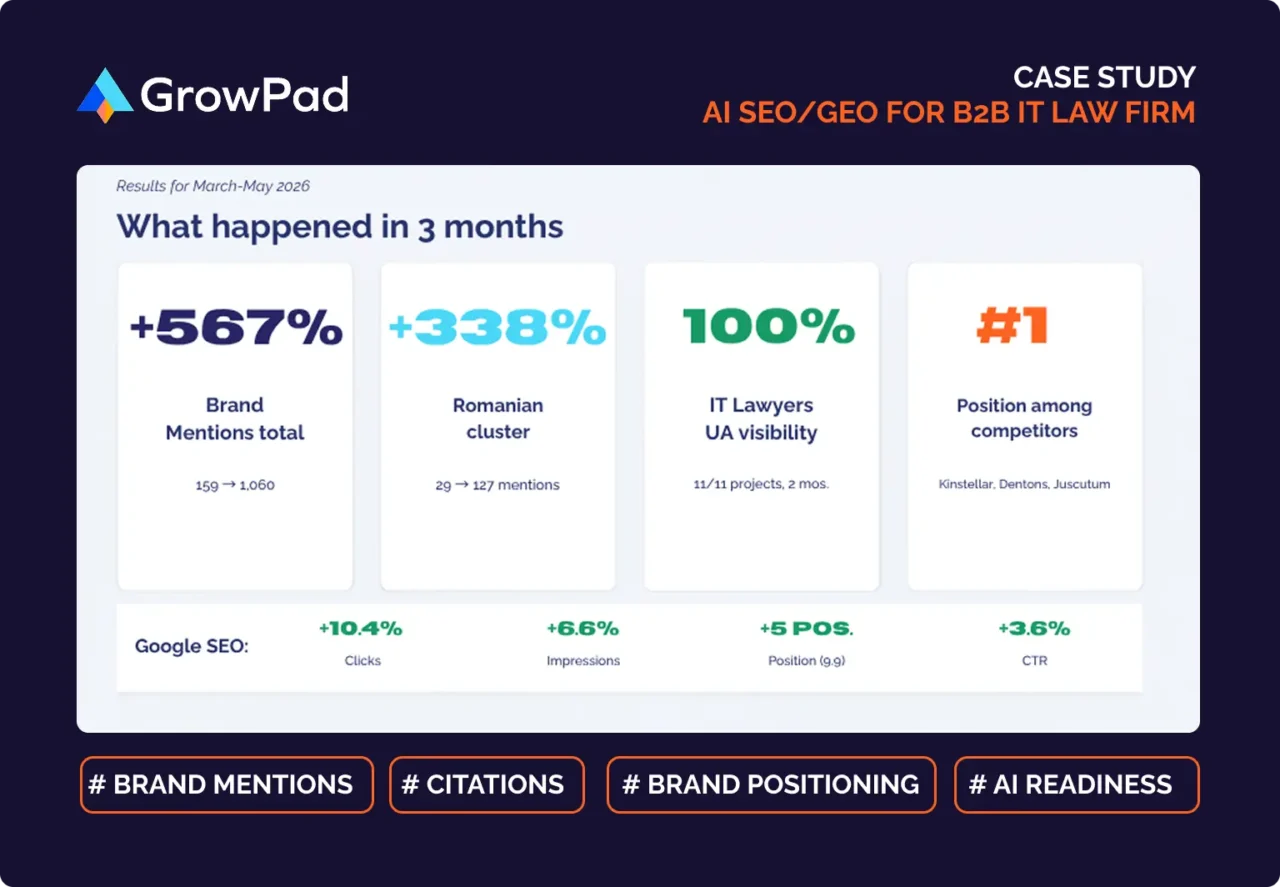
The March baseline showed a brand that was present but not dominant: visible in 25 of 34 tracked prompts, with 159 total mentions across all LLMs, and clear gaps in both the Romania cluster (weak English-language content) and the Diia.City cluster (average position behind a direct competitor).
Before GrowPad
With GrowPad
Want to Combine Law Firm SEO and AI Visibility?
What we did
- Step 1
- Step 2
- Step 3
- Step 4
- Step 5
Challenge 1: Three clusters at once, with no shared starting line
Most LLMO engagements concentrate on a single niche. The firm needed visibility across three at the same time: IT lawyers and Diia.City residency in Ukraine, and cross-border IT contracts in Romania. The three clusters were at very different stages.
The IT lawyers cluster was already close to full visibility, Diia.City was visible but sitting in second place behind a direct competitor, and the Romania cluster was barely surfacing in English at all. Treating all three the same would have wasted effort on the cluster that needed it least.
Our solution: Per-cluster baselines and portfolio-style prioritization
We measured each cluster separately and treated the program as a portfolio, not a single push:
– Set up tracking for 34 commercial-intent prompts split across the three clusters (11 IT lawyers, 13 Diia.City, 10 cross-border Romania)
– Established a per-cluster baseline for every KPI, so each cluster’s progress could be judged on its own curve
– Reallocated effort month to month: as the IT lawyers cluster hit and held 100% visibility, support shifted toward the two clusters with more room to grow
– Flagged the Romania cluster early as the weakest link, with a clear root cause — not enough authoritative English-language content for AI systems to draw on
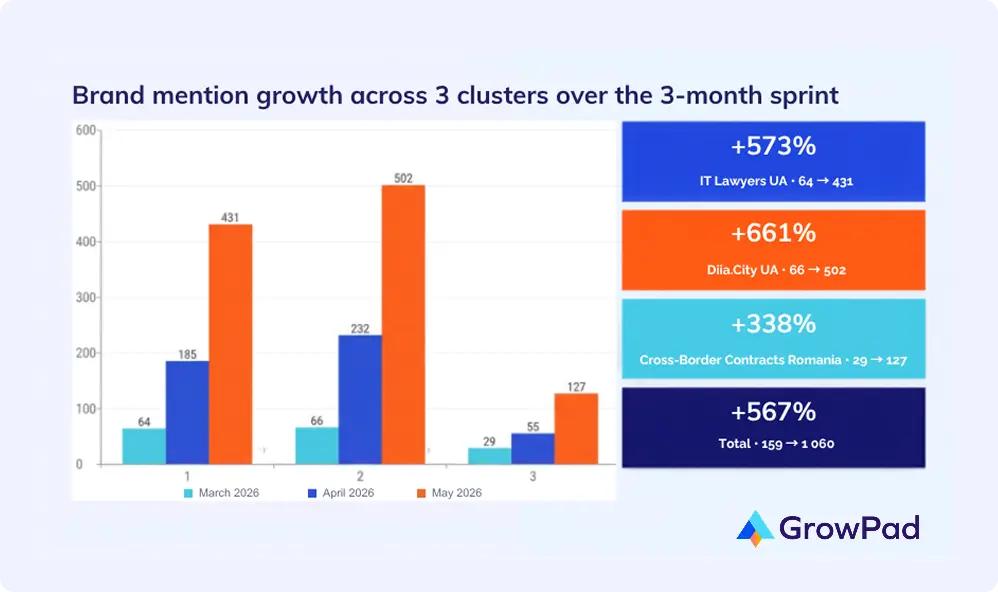
Result: All three clusters moved up together, and by May, the firm held #1 LLM position in each of them. The total trajectory — 159 → 472 → 1,060 mentions — was driven by deliberate reallocation, not by spreading effort evenly.

Challenge 2: A weak brand entity in LLMs and no systematic AI tracking
At the start of the sprint, the firm’s AI presence was real but unmeasured. There was no baseline, no agreed KPIs, and no way to tell whether month-to-month changes came from the work or from normal LLM fluctuation. For a brand competing against established international firms like Kinstellar, Dentons, and Juscutum, that made it impossible to prove the program was working.
Our solution: Mentions tracking setup and monthly AI reporting
We built the measurement layer before the visibility work, so every month could be evaluated against a baseline:
– Configured Otterly.AI tracking for the 34 commercial-intent prompts across the three clusters
– Set up five core KPIs per cluster: Brand Mentions, Average Brand Position, Brand Coverage Over Time, Visible/Total Tracked Prompts, and AI Readiness
– Produced monthly AI reports comparing the current month against the previous two, with month-over-month deltas on every metric
– Used each report to set the next month’s priorities, cluster by cluster
Result: Both teams could see exactly where AI authority was forming and where it had stalled. The month-by-month trajectory was tracked as it happened, which is what made the portfolio reallocation in Challenge 1 possible.
Challenge 3: Thin authority signals across all three clusters
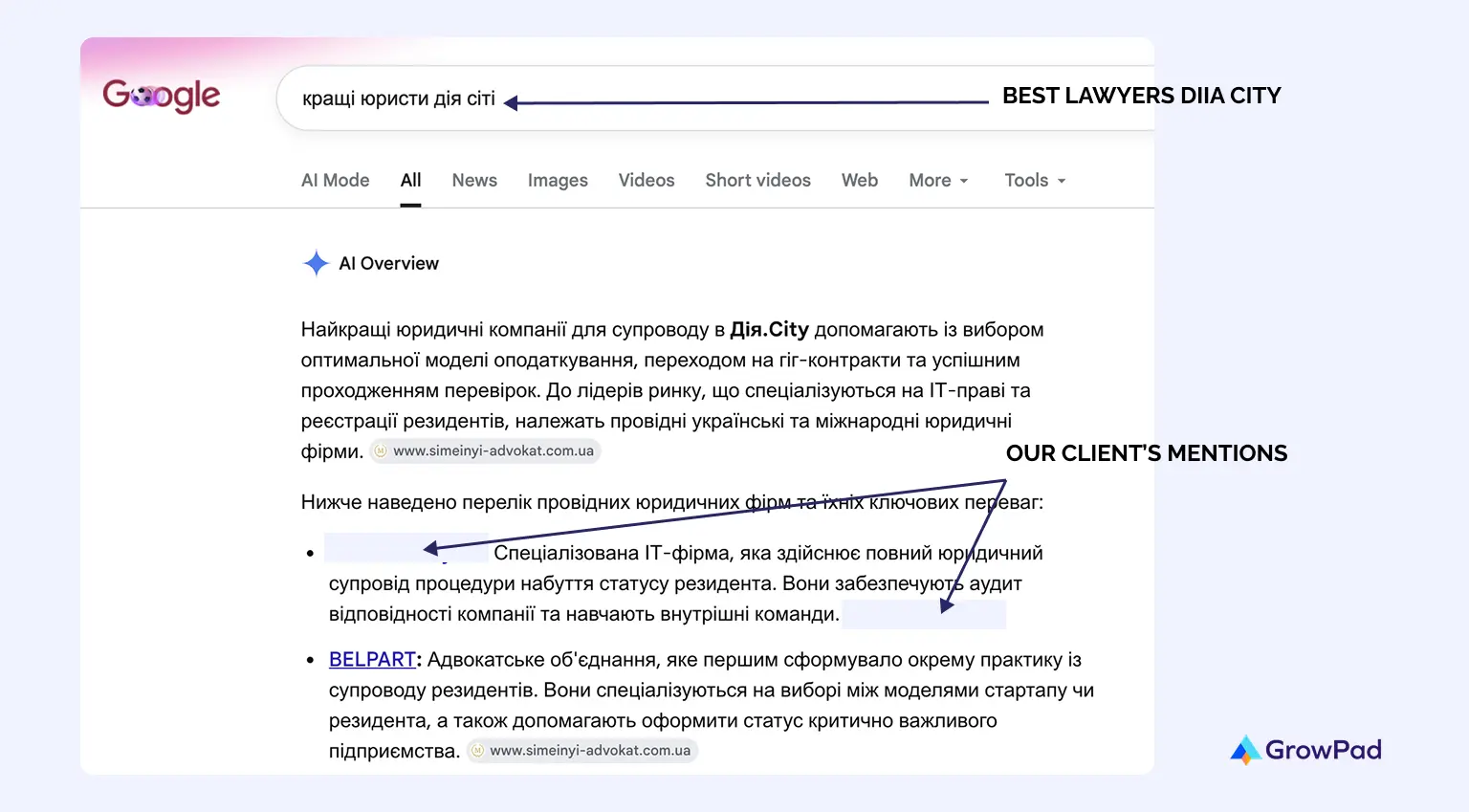
The firm had relevant service and landing pages, but the backlink and third-party trust signals behind them were thin, especially in the Romania cluster, where almost nothing existed in English. Structural AI-readiness work alone wasn’t going to move authority without external signals that LLMs already trust.
Our solution: GrowPad-owned listicle link-building per cluster
We ran link-building in-house to control quality and target it cluster by cluster:
– Focused placements on the priority service pages in each of the three clusters
– Prioritized listicle-format placements, which produce both faster SEO returns and the strongest AI-citation signals
– Conducted outreach to existing high-ranking listicles with proposals to add the firm vetting each host on two criteria: 1) it already ranks in Google for the target queries, and 2) it already appears as a cited source in AI answers for related prompts
– Concentrated English-language placements on the Romania cluster to close the gap AI systems were drawing attention to
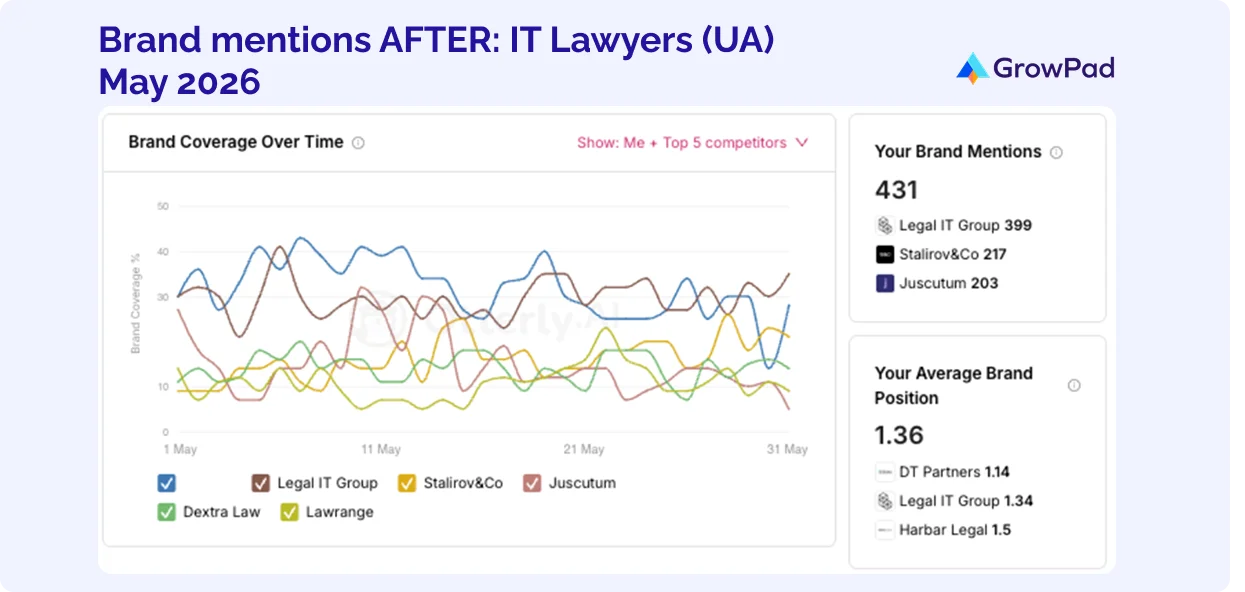
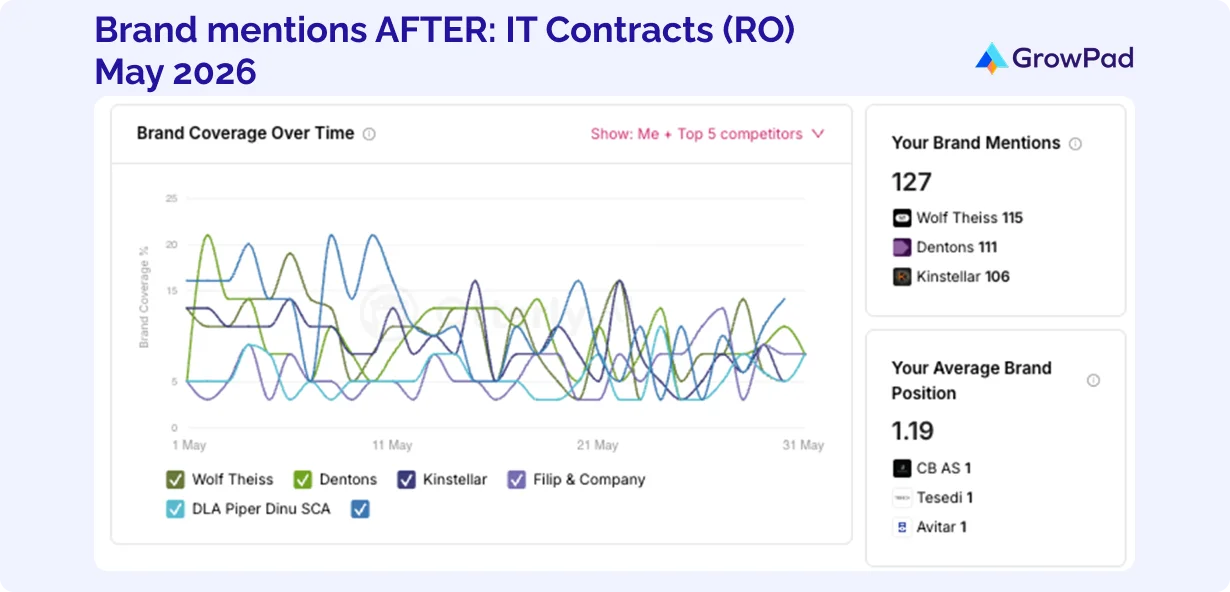
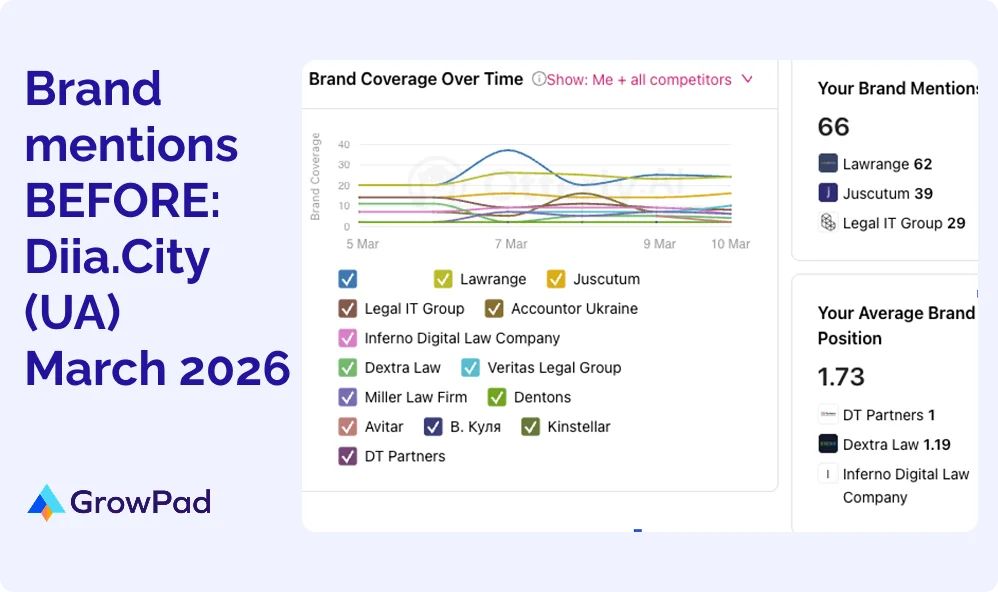
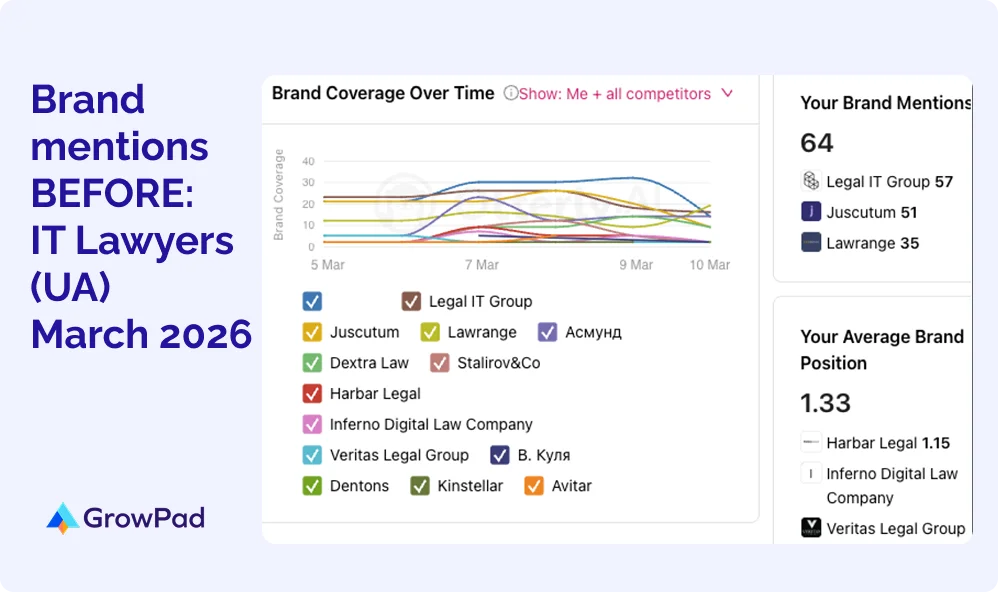
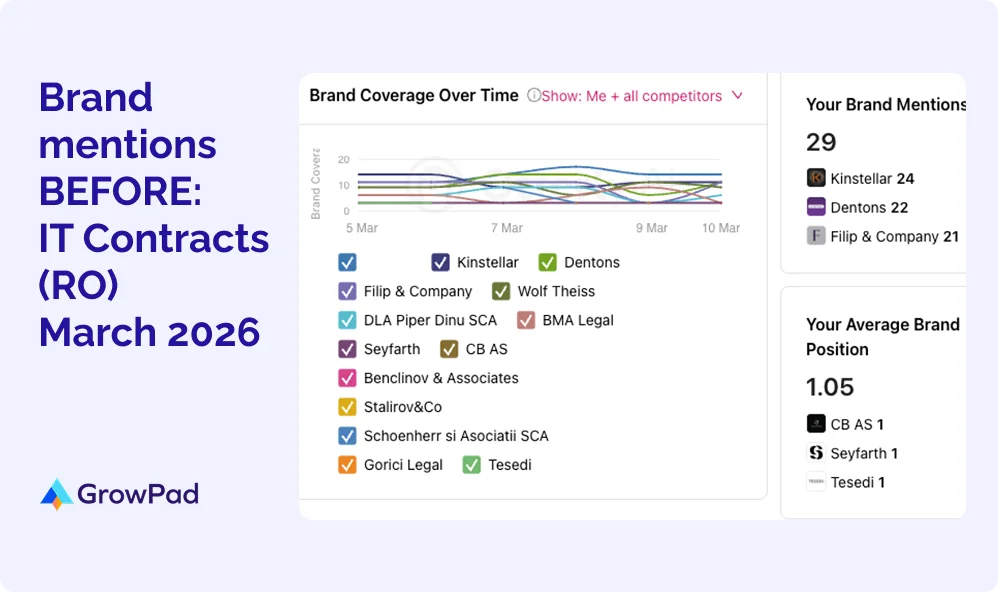
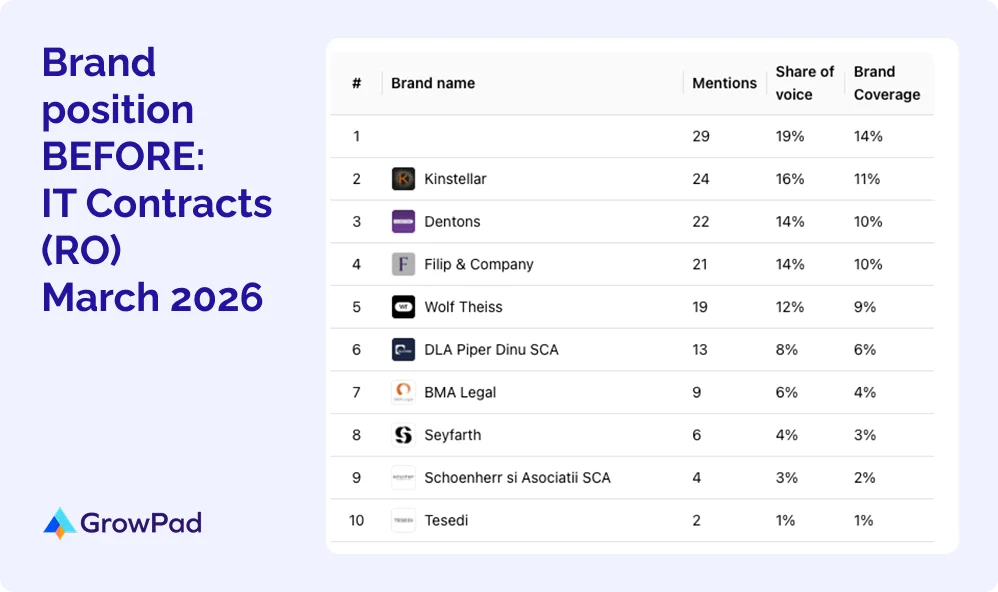
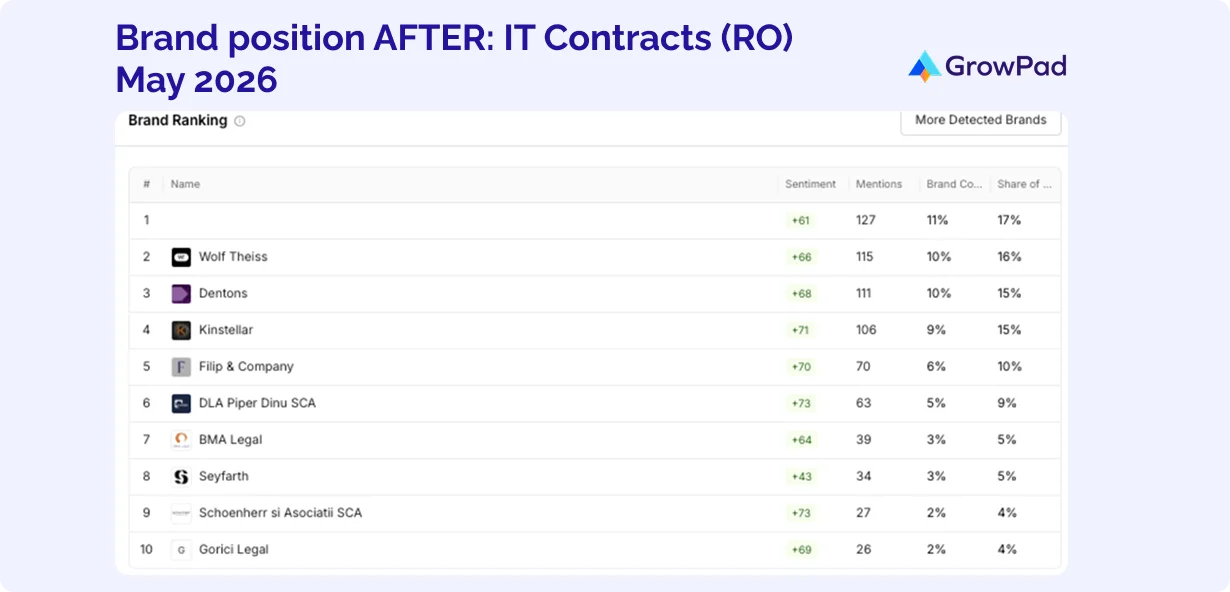
Result: Mentions climbed sharply across all three clusters — IT lawyers 64 → 431, Diia.City 66 → 502, Romania 29 → 127 — with the same listicle placements feeding both SEO and AI citation over time.
Law Firm SEO for AI Overviews Was Limited by JavaScript-Rendered Content
Some of the comany’s most important Diia.City content lived inside accordion / tab blocks that only rendered when a user clicked, meaning the underlying detail was loaded via JavaScript. Most AI crawlers don’t execute JS, so that content was effectively invisible to them, even though it was perfectly readable for a human visitor.
Our solution: Static-HTML rebuild and AI-citable structure
We rebuilt the affected content with both Google and LLM extraction in mind, addressing a common technical barrier in LLM SEO for law firms.:
– Converted the JS-rendered accordion content on the Diia.City pages into static HTML, so AI crawlers could actually read it
– Restructured priority content using AI-ready patterns: answer-first paragraphs, defined entity references, structured headings
– Optimized existing pages across the three clusters rather than rewriting from scratch, preserving the rankings already in place
– Flagged the constraint to the client’s dev team as a standing rule: important content must live in HTML, not load via JavaScript
Result: The Diia.City cluster, previously held back by hidden content, gained a full prompt in visibility (10/13 → 11/13) and improved its average position from 1.73 to 1.51 — the clearest single jump in the program.
Challenge 5: AI crawlers were being blocked at the robots.txt level
A crawlability check found that several AI crawlers — including GPTBot, OAI-SearchBot, PerplexityBot, ImagesoftBot, and Bytespider — weren’t explicitly allowed in the site’s robots.txt. Even with strong content, a brand can’t be recommended by an AI system that isn’t permitted to read the site.
Our solution: robots.txt configured for AI access
We brought the robots.txt in line with what AI systems need to read and cite the site:
– Explicitly allowed the major AI crawlers (OpenAI’s GPTBot and OAI-SearchBot, Anthropic’s ClaudeBot, PerplexityBot, ImagesiftBot, Bytespider)
– Added an llm.txt allowance and confirmed the sitemap reference
– Re-ran the crawlability check the following month to confirm the bots were being admitted
Result: With access opened up, more AI systems could read and reference the site, which broadened where the law firm could be picked up across ChatGPT, Perplexity, Gemini, and Claude.
Key results
After three months of focused work across the three clusters, every tracked AI KPI moved in the right direction:
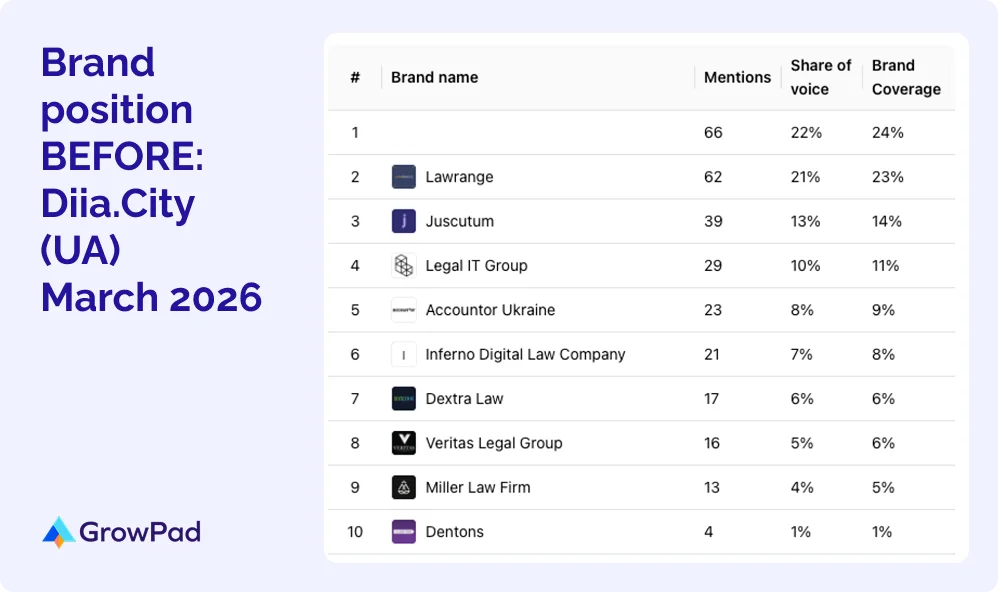
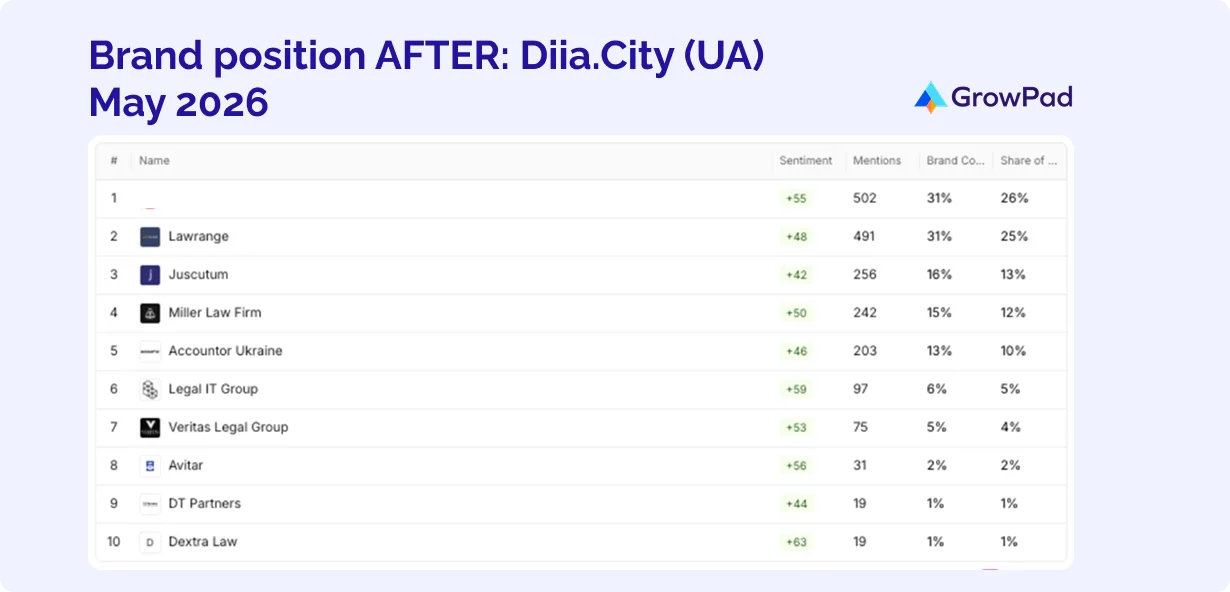
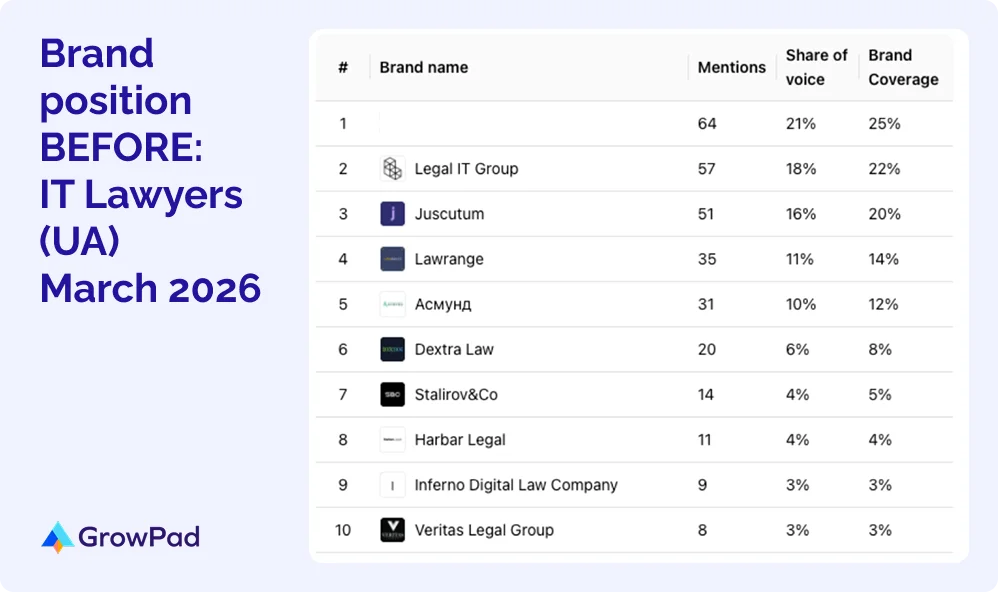
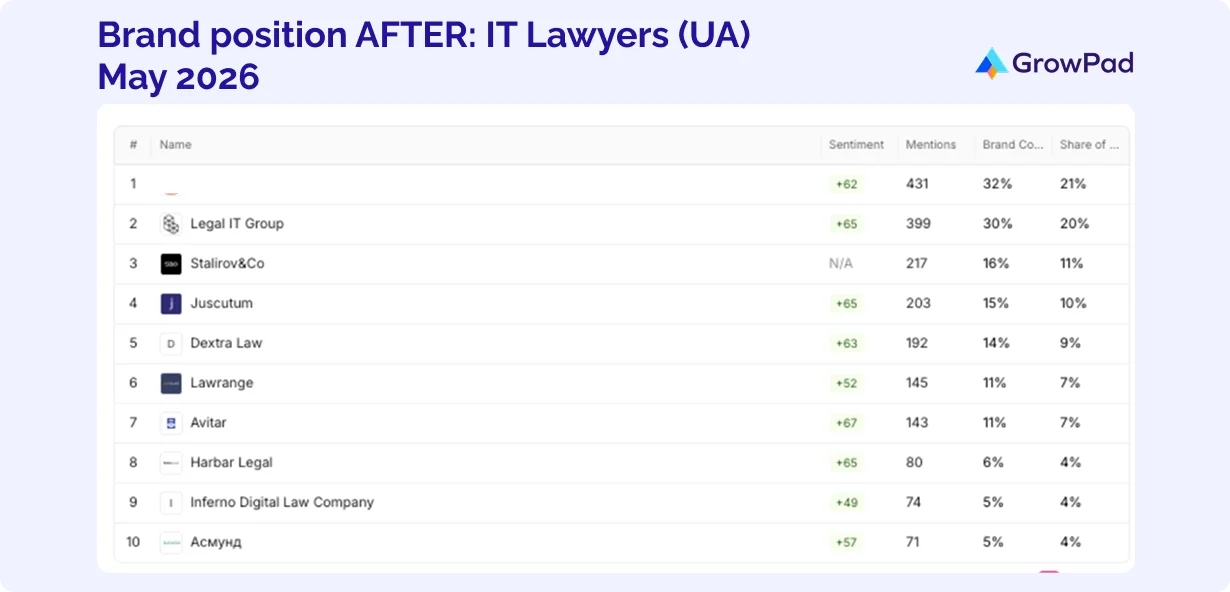
“Great work, friends! I’m starting to feel the results in reality. The number of leads has really increased. Thank you, you guys are awesome.”
CEO, IT law firm (name withheld under NDA)
What to apply
Measure each cluster separately and move effort toward the ones with room to grow. Once the strongest reaches full visibility, holding it costs little, so the budget belongs to the weaker clusters.
A mentioned headline tells you the brand shows up, not for which queries or service line. Build a prompt set per cluster and check coverage monthly in N/total format.
If key detail loads inside accordions or tabs, AI systems usually can’t read it, even though visitors can. Moving that content into static HTML produced the clearest positional gain here.
A brand can’t be recommended by an AI system that isn’t allowed to read the site. Explicitly allow the major AI crawlers before investing in deeper visibility work.
For Romania, the gap wasn’t strategy but a lack of authoritative English content for AI to draw on. Naming the specific gap is what made it fixable.
Ready to make your brand the most cited answer across every service line you offer?
With GrowPad expertise, you can build the same kind of AI visibility, SEO authority, and prompt-level dominance, but across your own clusters and pipeline goals.
Frequently Asked Questions
How long does it take to see results from AI SEO / AEO work for a B2B legal or consulting firm?
In this law firm AI SEO case study, total brand mentions in LLMs moved from 159 to 1,060 per month within three months of focused work across three service clusters. The clearest single gains — 100% prompt visibility in the IT lawyers cluster and a positional jump in the Diia.City cluster — landed within the first two months.
Realistic timelines depend on three things: 1) how clearly each cluster is defined at the start, 2) whether the firm already has a reasonable SEO and content foundation, and 3) how many technical blockers (like JavaScript-rendered content or a restrictive robots.txt) are sitting in the way. Firms with a stronger existing foundation tend to see AI citation patterns emerge faster, because LLMs lean on many of the same trust signals Google has already evaluated.
For most B2B professional-services firms starting from a reasonable baseline, 90 days of consistent, cluster-focused work produces measurable shifts in AI visibility.
Can you really grow AI visibility across multiple service lines at once, or do you have to pick one?
You can run several at once. The discipline is in how you allocate effort. In this law firm AEO case study, GrowPad tracked three clusters separately (IT lawyers, Diia.City residency, and cross-border IT contracts) and treated them as a portfolio. As one cluster reached 100% prompt visibility, support shifted toward the clusters with more room to grow.
The key is per-cluster measurement. Without separate baselines and prompt sets for each service line, a single aggregate "mentions" number hides which clusters are working and which are stalling, and you end up over-investing in the niche that needs help least.
What does "prompt-level visibility tracking" mean, and why does it matter more than aggregate brand mentions?
A "1,060 mentions per month" headline tells you the brand is appearing in AI answers somewhere, but not for which buyer queries. Two firms with identical mention counts can have very different commercial value depending on whether they show up for high-intent prompts like "best legal partner for Diia.City residency" or low-intent ones like "what is Diia.City."
Prompt-level tracking solves this. You build a set of buyer-intent prompts representing the questions your clients actually ask AI tools, then track each month how many surface your brand, in N/total format. In this AEO/GEO for law firm project, the tracked set was 34 prompts across three clusters, and total visibility moved from 25/34 in March to 29/34 in May.
How can a brand appear in AI search results when it's new to a market or service line?
When you're entering a new cluster, AI systems usually have little or no authoritative content about you to draw on, so you start close to invisible. That was the situation for the new Romanian market in this law firm AI SEO case: the Ukrainian clusters had a deeper content and authority base, while the Romanian one was a near-standing start in English.
The path is to build the trust signals AI systems read before they'll recommend you. In practice, that meant concentrating English-language listicle placements and content on the Romania cluster specifically. Mentions grew from 29 to 127 over the 30month sprint: slower than the established clusters, but enough to take the brand from invisible to surfacing in AI answers in a market it had just entered.
How should you distribute effort across several clusters when the main one already performs well?
Move it toward the clusters with the most room to grow. Once a cluster reaches full prompt visibility and sits at #1, holding that position costs far less than getting there, so continuing to pour effort into it produces diminishing returns. In this law firm AEO services engagement, once the IT lawyers cluster hit 100% visibility (11/11) and held it, support shifted to the two clusters with more headroom, Diia.City and Romania. That reallocation is exactly what a portfolio approach is for.
Is GrowPad a good fit for B2B firms that serve the tech sector and want to dominate AI answers?
GrowPad works best with B2B firms whose offerings are complex, niche-driven, and hard for AI systems to interpret without structured signals. That describes a law firm built around IT/tech clients as much as it does a software company. GrowPad's GEO services for law firm clients center on per-cluster demand and tracking, AI-ready content structure, technical AI-readiness (crawlability and static-HTML content), and third-party trust signals built through editorially vetted listicle placements.
Firms that benefit most are those willing to commit to their clusters long enough for compounding signals to take hold — typically 90+ days — rather than chasing visibility everywhere at once.
