


EDTECH SEO & AI VISIBILITY CASE STUDYHow we grew Blue Carrot AI citation share 1%→8% in 60 days and +25% SQLs in 90 days
About the client
Blue Carrot is a Poland-based e-learning product company and marketing video maker serving clients globally. This EdTech SEO case study covers the company’s organic lead growth and expansion into AI search. The company combines science-based learning methods, AI technology, and diverse media formats to deliver scalable educational solutions from short explainers to large multilingual e-learning programs.
In early 2025, Blue Carrot partnered with GrowPad to support existing SEO results, transition from a previous vendor, and realign organic growth with an updated business positioning.
As AI-driven discovery grew through 2025, the work expanded into a dedicated AI visibility (LLMO) track, optimizing how Blue Carrot is cited and recommended inside ChatGPT, Gemini, Perplexity, and Google AI Overviews.
Project overview
Client: Blue Carrot
Region: Worldwide
Industry: EdTech SaaS / E-learning servicesProject duration: Jan 2025 – Feb 2026
Overall partnership: Jan 2025 – Feb 2026
Project goals
– Maintain and scale existing SEO performance
– Support a shift in business positioning
– Increase leads from priority service pages
– Grow brand visibility in AI search
Starting point
Blue Carrot entered the project with a functioning SEO base and stable technical setup. The site did not suffer from critical technical issues, but growth had plateaued. At the same time, AI search was beginning to reshape how buyers found and shortlisted e-learning agencies, and Blue Carrot had no structured presence in those AI answers yet.
Key constraints included:
– Tight SEO budget
– The need to preserve existing results during transition
– Reliance on a strategy created by a previous SEO advisor
– No structured approach to AI/LLM visibility
The challenge was not fixing broken fundamentals, but extracting more value from what already worked while aligning SEO with new business priorities, and building a presence in AI search before competitors did.
Before GrowPad
With GrowPad
Looking for EdTech SaaS Growth and AI Visibility Services?
What we did
- Challenge 1
- Challenge 2
- Challenge 3
- Challenge 4
Scaling SEO while protecting existing results
Blue Carrot needed an eLearning SEO company that could grow organic leads without destabilizing the rankings and visibility it had already built. Any abrupt strategy changes carry risk, especially during the transition from a previous vendor.
Our solution: Structured prioritization model
GrowPad introduced a three-level page prioritization framework and focused execution on the first two tiers: pages already generating leads and pages with clear near-term potential.
This allowed the team to:
– Direct effort where impact was most predictable
– Avoid unnecessary changes to low-risk areas
– Support growth without disrupting baseline performance

Supporting a shift in business positioning through SEO
Blue Carrot was refining how it presented its services and value proposition. SEO had to reflect this shift without fragmenting authority or confusing search intent.
Our solution: Cluster expansion around core services
Instead of spreading our effort across many unrelated topics, we focused on one core content cluster and deliberately expanded it.
This included:
– Creating new service and landing pages aligned with updated positioning
– Optimizing existing pages for clarity and relevance
– Reinforcing internal linking within the cluster
As a result, search engines and AI systems began associating Blue Carrot e-learning SaaS more clearly with its priority service areas.

Growing authority with a limited SEO budget
Budget constraints required careful selection of tactics. Broad experimentation or large-scale content production wasn’t an option.
Our solution: Focused content + targeted link-building
We concentrated resources on:
– Strengthening depth and coverage within priority clusters
– Building links selectively to pages with direct lead impact
This approach improved rankings for commercial queries and contributed to increased visibility in both traditional search and LLM-driven results.

Building visibility inside AI search before competitors
By late 2025, buyers were increasingly asking ChatGPT, Perplexity, and Google AI Overviews questions like “Which agencies provide custom storyline course development?” Blue Carrot had strong content but was not yet structured to be cited or recommended consistently in those AI answers, and brand mentions lagged behind domain citations, especially in ChatGPT.
Our solution: A dedicated AI visibility (AEO/GEO) track
We treated AI visibility as its own workstream layered on top of SEO, covering a technical AI audit, page-level LLMO optimization, LLM-adapted FAQs, listicle distribution, and monthly AI tracking. The full breakdown is in the section below.
Going beyond search: the AI visibility layer
Strong SEO makes AI visibility possible, but in 2026, buyers shortlist vendors inside AI answers, so GrowPad built a focused AI visibility track to get Blue Carrot cited and recommended by the models buyers use to choose an agency.
1. Technical AI audit
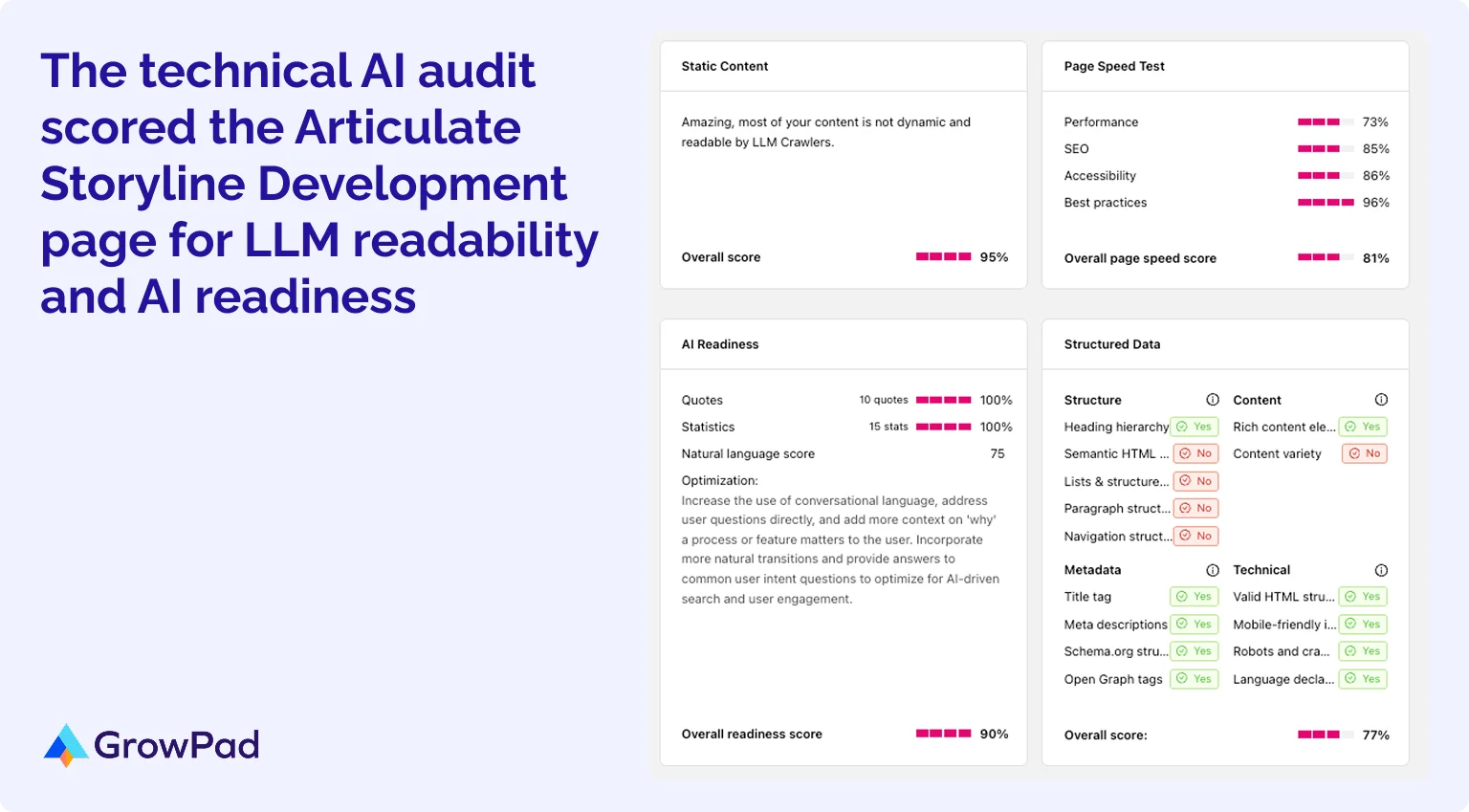
We assessed how readable, structured, and citable the site was for LLMs, and found AI systems pulling Blue Carrot’s domain without surfacing the brand name. That gap shaped the rest of the work.
2. Page analysis & LLMO optimization
Our team optimized four priority pages for AI citation (Articulate Storyline development, eLearning content development, video production, and course development) and added LLM-adapted FAQ sections matching how buyers phrase questions to AI tools.
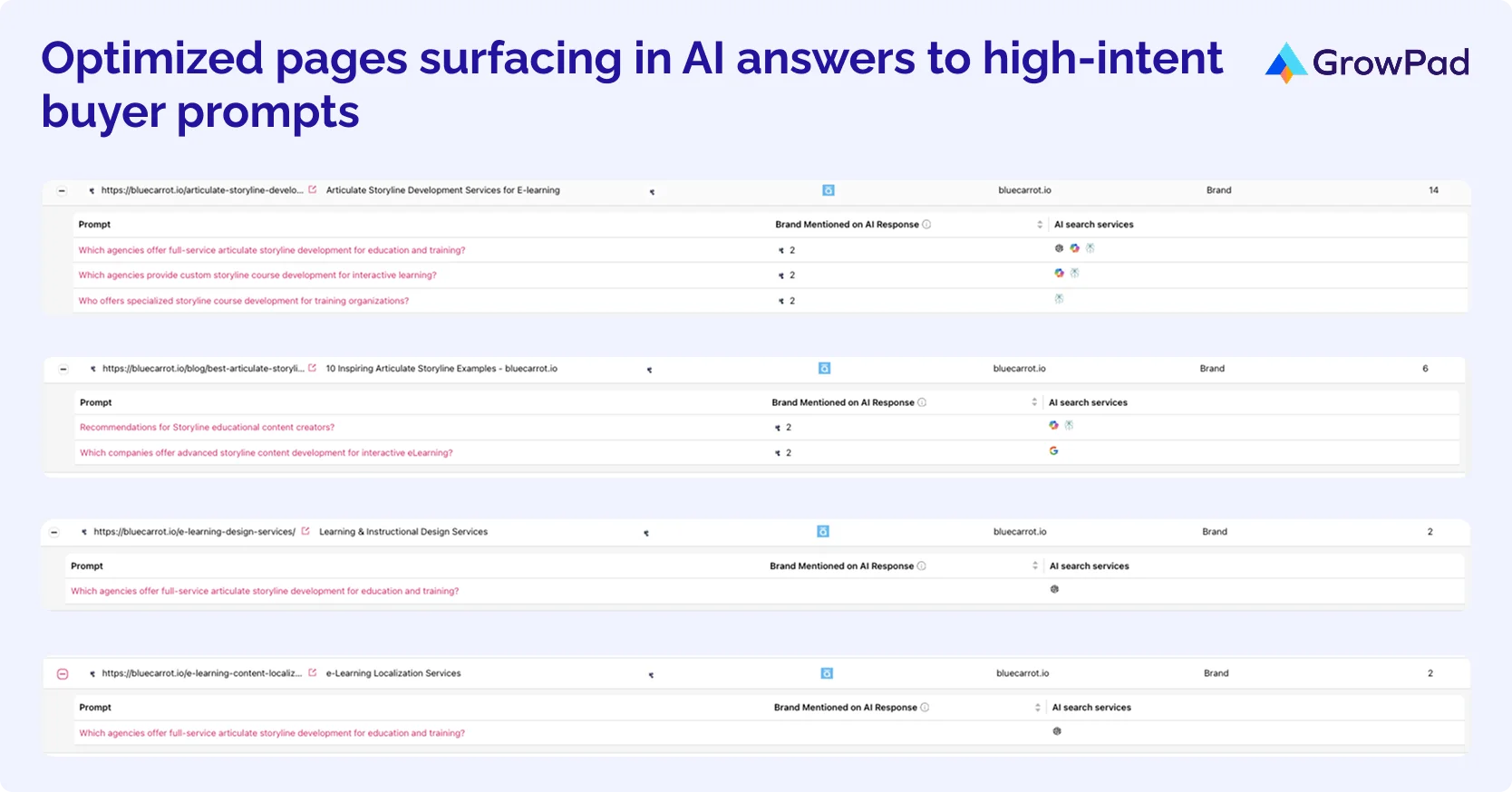
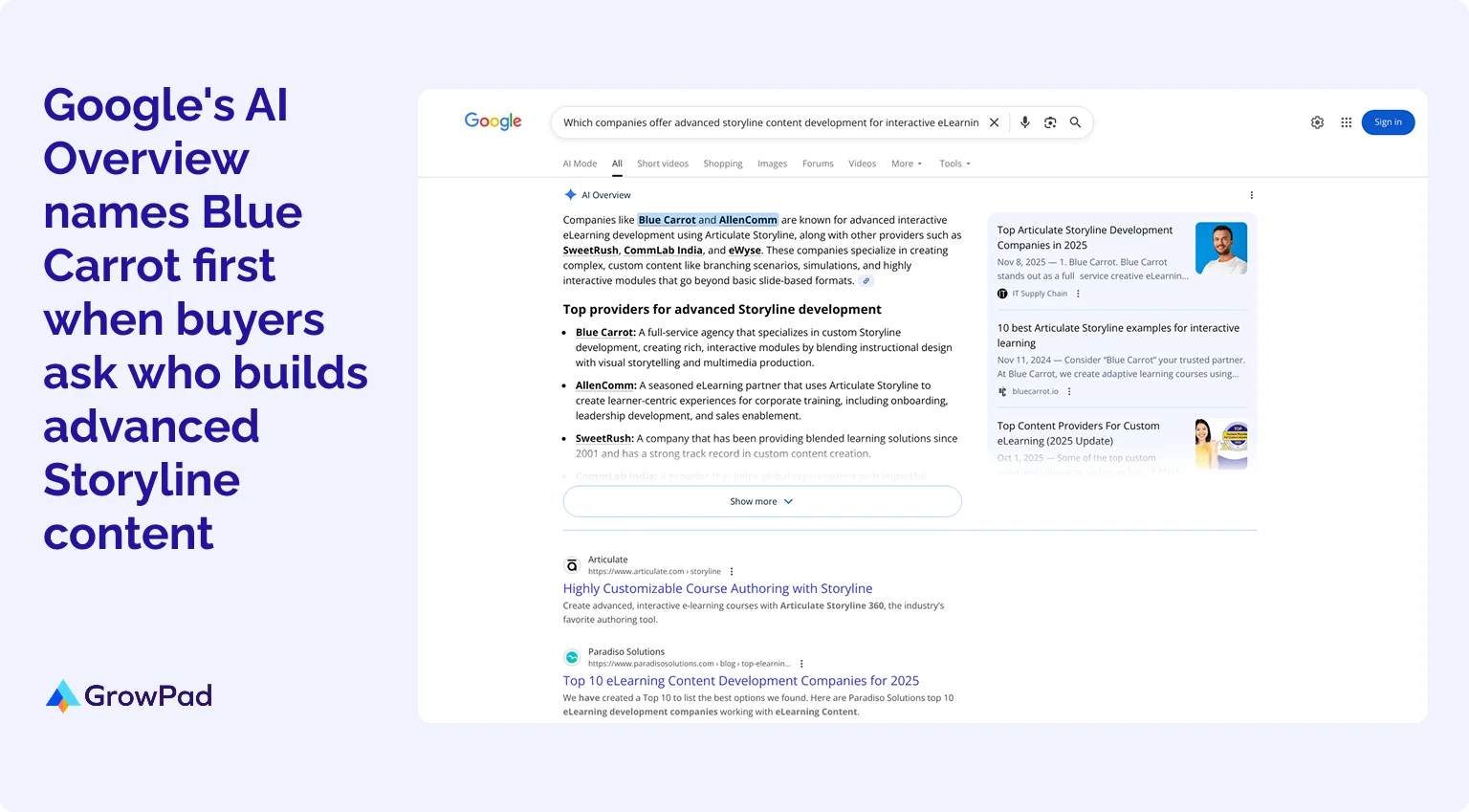
Citation Share in Google AI Overview grew from 1% to 8% (December 2025 to January 2026), and these pages were cited in answers to high-intent prompts such as “Which agencies provide custom storyline course development for interactive learning?”
4. AI visibility tracking & reporting
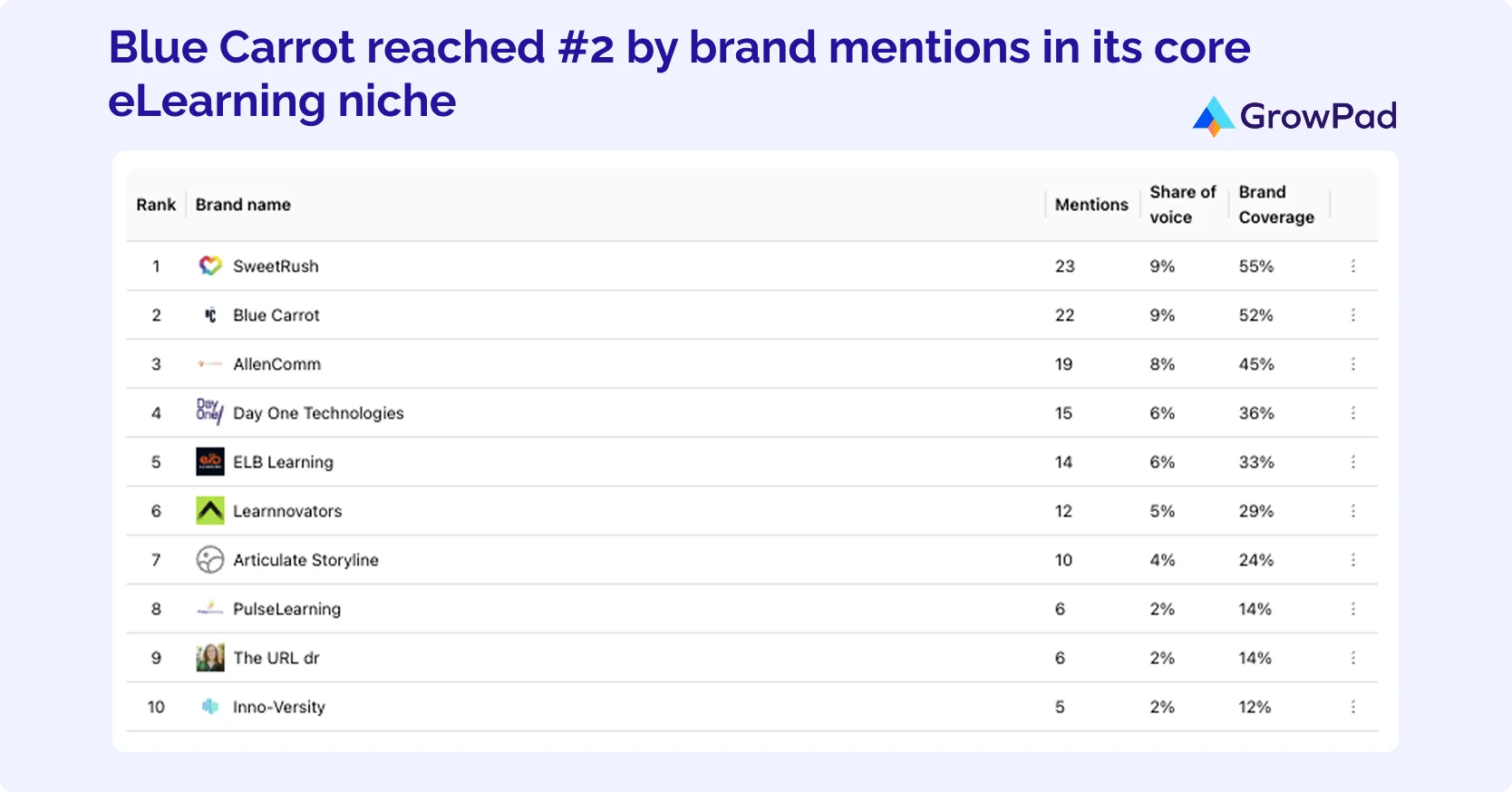
We tracked brand mentions, citations, and position across AI Overview, Perplexity, ChatGPT, and Copilot monthly. Blue Carrot held Top-2 brand position in AI Overview (~#2.3) and Perplexity (~#1.7), with a strengthening ChatGPT position (~2.04 to ~1.94). As the Storyline niche stabilized, we re-tuned tracking toward the broader e-learning content development niche.
The nuance: visibility up, AI clicks down
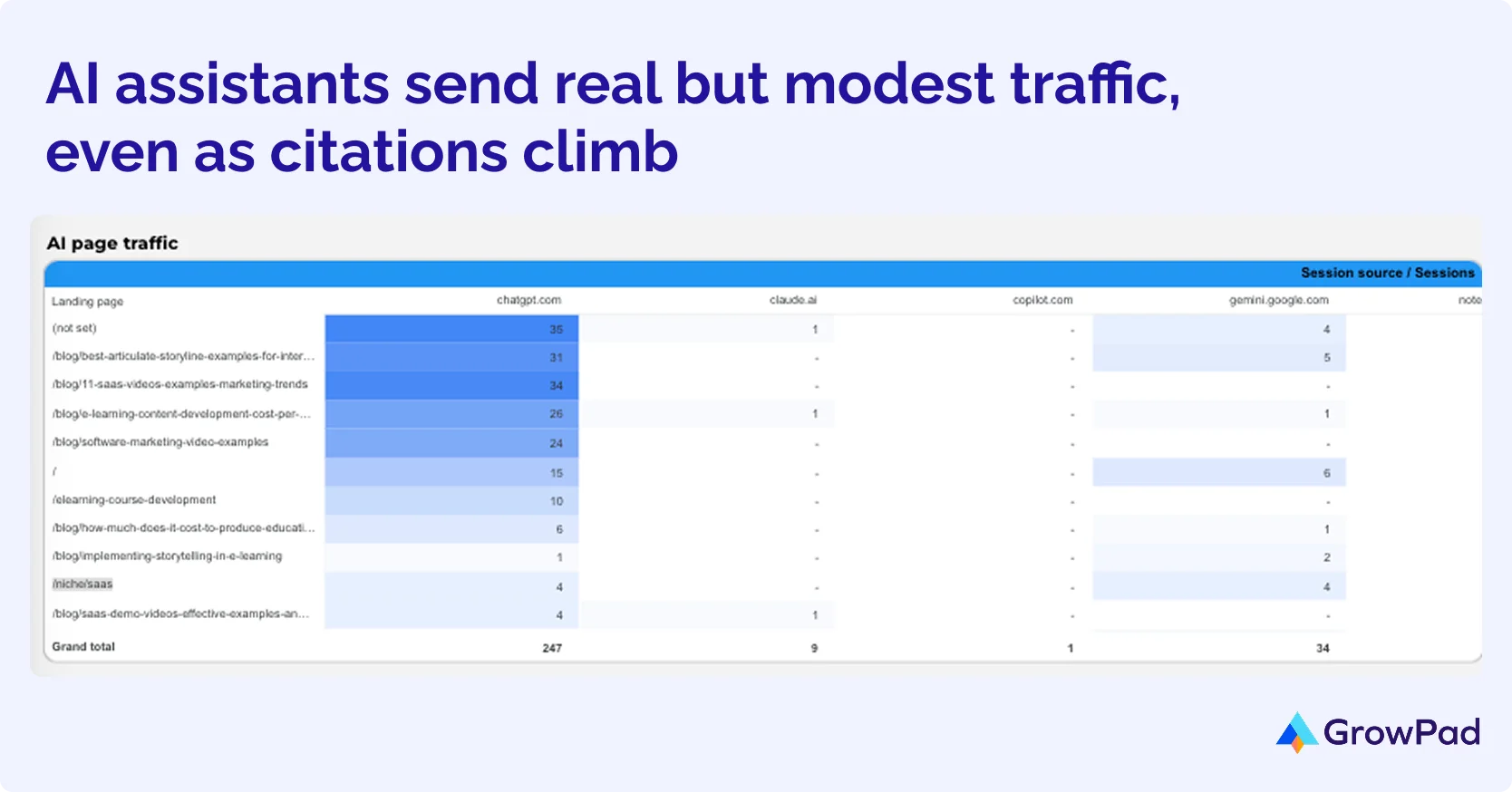
Over the same period, direct AI-referral traffic stayed flat to slightly down even as citations and brand position rose. This is an industry-wide pattern in 2026, not a Blue Carrot problem:
– Users get a complete answer inside ChatGPT or AI Overviews and don’t click through; the citation confirms expertise rather than acting as an entry point.
– A #2-3 position in AI answers drives roughly the traffic of a #6-7 classic search position.
– Since mid-2025, ChatGPT shows external links less often, reducing referral traffic for every commercial site.
Key results
Within the first three months of collaboration and on, Blue Carrot edtech SaaS saw tangible SEO improvements, with AI visibility gains compounding through late 2025 and early 2026:


How we did it

“Their professionalism and attention to detail made the entire workflow efficient and stress-free. The team stayed proactive, communicated clearly, and consistently aligned SEO and content decisions with our business goals, which helped us see tangible improvements in visibility and lead generation.”
Tim Aleksandronets
CEO, Blue Carrot
What to apply
Instead of spreading effort across many unrelated pages, select one core service cluster and expand it deliberately. Depth within a focused topic helps search engines and AI quickly associate your brand with specific expertise.
Not all pages deserve equal attention. Identify which service pages already generate leads or support sales conversations, and concentrate optimization and link-building there before expanding further.
Adding more pages only works when the core cluster is strong. Expanding existing topics with supporting pages, use cases, and clearer intent coverage often produces better results than launching new clusters too early.
Clear structure and strong SEO open the door, but reaching Top-2 in AI answers takes deliberate work: a technical AI audit, LLM-adapted FAQs on commercial pages, listicle distribution, and monthly tracking of brand mentions and position across ChatGPT, Perplexity, Gemini, and AI Overviews.
In 2026, AI answers often resolve a query without a click. Being cited and recommended shapes the buyer’s shortlist before they reach your site, so track citation share and brand position alongside referral traffic.
With limited resources, focused execution outperforms broad experimentation. Tight prioritization allows meaningful gains even when content production and link-building capacity are constrained.
Ready to elevate your organic growth strategy?
With GrowPad expertise, you can achieve the same, if not better, results from your SEO, AI, and PR strategies.
Frequently Asked Questions
How does SEO help e-learning SaaS companies generate more qualified leads?
SEO helps e-learning SaaS companies generate qualified leads by aligning content with specific buyer use cases, and an experienced elearning SEO company structures this around how vendors are actually evaluated: pricing models, delivery formats, and scalability. Service pages, solution pages, and industry-specific content tend to convert better than general learning resources.
When SEO service for SaaS is structured around how buyers evaluate vendors (e.g., pricing models, delivery formats, scalability, and outcomes), organic traffic becomes more sales-ready and easier to qualify.
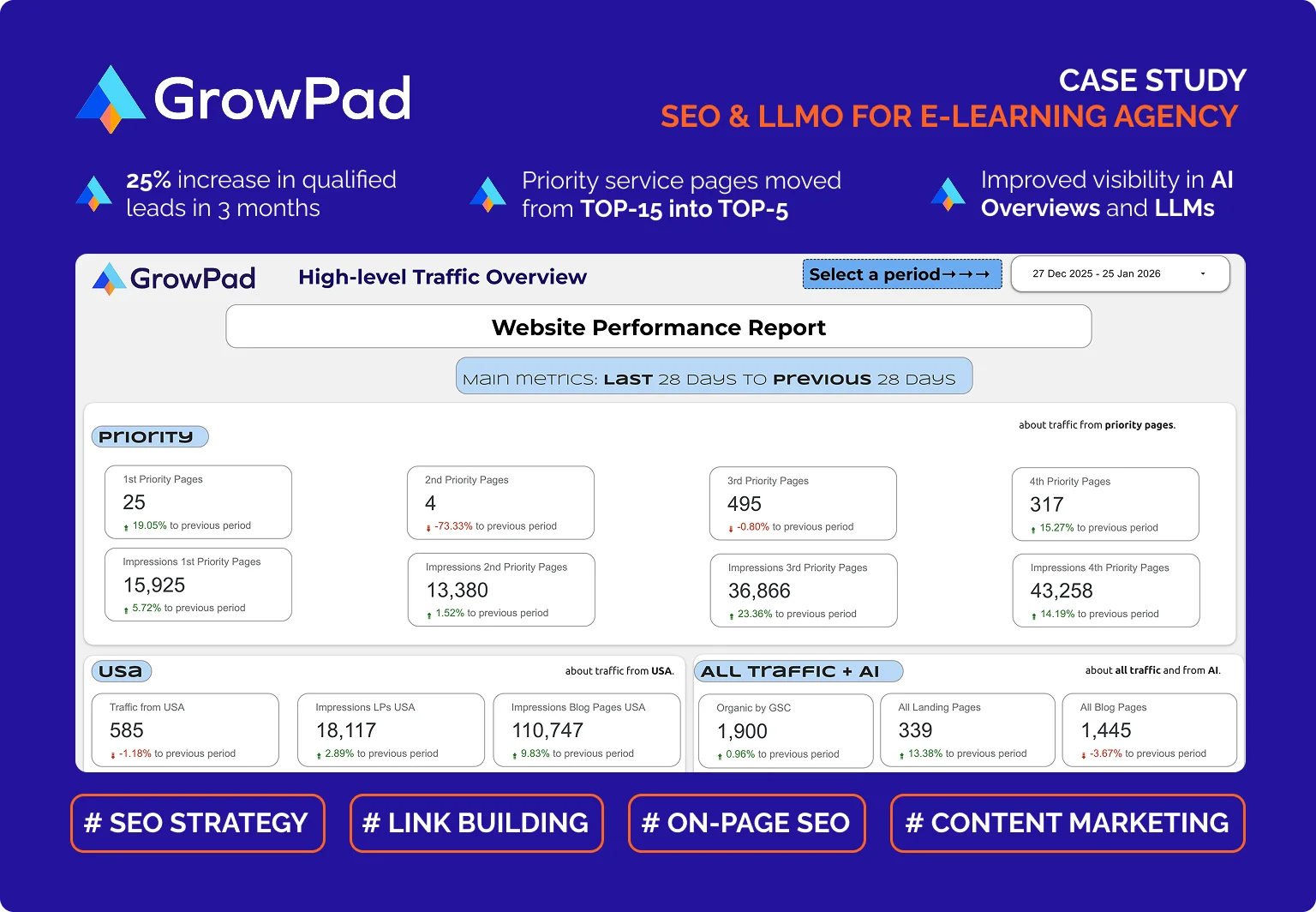
For example, in this e-learning SEO& GEO case study, GrowPad worked with Blue Carrot to shift focus toward service and solution pages that reflected real buying scenarios. As a result, organic traffic became more sales-ready, contributing directly to a 25% increase in qualified leads within three months.
What makes SEO different for e-learning and educational SaaS products?
E-learning SaaS SEO requires balancing educational depth with commercial clarity. Many providers attract traffic interested in learning theory rather than purchasing services or platforms.
Effective SEO separates informational content from service-driven pages, allowing search engines and users to clearly understand which pages are meant to educate and which support buying decisions.
In this SEO and LLMO case for e-learning SaaS, that separation helped search engines - and AI systems - understand which pages supported discovery and which supported decision-making.
How can SEO support a change in the business positioning of your SaaS?
SEO supports SaaS positioning shifts by reshaping how services are grouped, named, and internally linked. Page structure and terminology signal to search engines what the company wants to be known for.
For Blue Carrot, GrowPad re-aligned existing content around newly prioritized services instead of launching everything from scratch. This allowed visibility to gradually move toward the new positioning without losing existing authority, a common risk during SaaS repositioning.
How does GrowPad prioritize pages for SEO in edTech SaaS projects?
GrowPad prioritizes pages based on their contribution to lead generation rather than traffic volume. Pages are grouped into priority tiers depending on whether they already generate leads, support sales conversations, or show near-term potential.
In this e-learning SEO case study, that prioritization meant concentrating optimization and link-building on a limited set of service pages first. This focus allowed results to compound where business impact was most predictable, before expanding SEO efforts further.
Why is topic authority important for e-learning SaaS SEO?
Topic authority helps search engines associate a company with a specific domain of expertise. For e-learning providers, this often means going deep into one service category instead of covering many unrelated topics.
Strong topic authority improves ranking stability and increases the likelihood of appearing in AI Overviews and LLM-generated responses. For example, in the Blue Carrot SaaS SEO project, GrowPad deliberately expanded one core content cluster instead of launching multiple new ones. This depth improved ranking stability and increased visibility in both traditional search and AI-driven discovery surfaces.
How long does it take to see SEO results for an e-learning SaaS?
Initial SEO signals often appear within two to three months when priority pages are optimized and internal linking is improved. More competitive gains usually follow as content depth and authority increase. Results tend to accelerate when SEO builds on an existing foundation rather than starting from zero.
How does link-building support SaaS SEO without large budgets?
With limited budgets, link-building works best when focused on pages that already align with buyer intent. Links to priority service pages help reinforce relevance and improve competitive positioning.
Targeted link-building combined with strong content often outperforms broad outreach campaigns. In this e-learning SEO case study, GrowPad used focused link-building to support already-optimized pages, which helped improve rankings and visibility without relying on high-volume outreach campaigns.
What is AI visibility, and how is it different from SEO in Edtech projects?
AI visibility is the practice of getting an edtech brand cited and recommended inside AI answers from tools like ChatGPT, Perplexity, and Google AI Overviews. It builds on SEO but adds its own work: a technical AI audit, LLM-adapted FAQ content, listicle distribution, and tracking of brand mentions and position across each AI engine.
For Blue Carrot, an e-learning product and marketing video maker company, GrowPad ran AI visibility as a dedicated track. Within two months, Citation Share in Google AI Overview rose from 1% to 8%, and the brand reached Top-2 positions in AI Overview and Perplexity for its core e-learning prompts.
Does AI visibility actually drive traffic and leads for edtech projects?
AI visibility increasingly shapes which vendors a buyer shortlists, often before they ever visit a website. These days, many AI answers resolve a query without a click, so direct AI-referral traffic can stay flat even as citations and brand position rise.
This is why AI visibility is best measured by citation share and brand position, not only referral clicks. For Blue Carrot, an e-learning SaaS, being cited and recommended in AI answers for high-intent prompts put the brand in front of buyers at the exact moment they were choosing a tool, which supports lead quality over time.
What SEO and AI visibility metrics matter most for e-learning SaaS companies?
For SEO, the most relevant metrics are qualified leads, conversion rates on service pages, and engagement on priority content. Rankings and traffic serve as indicators, but they are secondary to lead quality.
For AI visibility, the key metrics are citation share, brand position across AI engines, and brand mentions versus domain citations. In one SEO and LLMO case for e-learning SaaS, GrowPad tracked performance at the page and cluster level for SEO, and tracked citation share and brand position across ChatGPT, Perplexity, and AI Overviews for AI visibility, which made it easier to connect each activity to lead growth results.
Is GrowPad a good fit for e-learning SaaS SEO & GEO/AEO campaigns?
GrowPad works well with e-learning SaaS companies that want SEO to support lead generation and long-term positioning rather than short-term traffic gains.
For example, in this edtech SEO & GEO/AEO case study with Blue Carrot, GrowPad focused on topic authority, page prioritization, and AI visibility to support both current results (+25% more qualified leads in 3 months) and future growth (1% to 8% AI Overview citation share, Top-2 brand positions in AI answers).
